
This post contains affiliate links. We may earn a small commission at no extra cost to you. See our disclosure.
Here’s how to get pet hair out of carpet: loosen it first, then lift it out. Drag a rubber broom, a squeegee or a slightly damp rubber glove across the carpet to pull the buried hair up to the surface. Then vacuum slowly in two directions with the brush roll on. That one-two routine gets out far more dog and cat hair than any single pass with a vacuum.
You already know the frustrating part. You vacuum the living room and it looks clean. Then the sun hits the rug at an angle and there’s a gray fuzz of undercoat sitting right in the fibers. It isn’t that your vacuum is broken. Pet hair works its way down into carpet and hangs on, and suction alone can’t always pull it back out.
Below you’ll find nine methods that work, which ones suit your type of carpet, what to do when your vacuum “stops picking up hair,” how to handle stairs, and a simple schedule that keeps the fur from building up again.
🐾 Quick Answer: How to Get Pet Hair Out of Carpet
- Loosen: rubber broom, carpet rake, squeegee or damp rubber glove, short strokes toward you.
- Lift: pick up the clumps by hand or with a dustpan.
- Vacuum: slow, overlapping passes, then again at a right angle. Brush roll on for cut pile.
- Finish: lint roller on edges, empty the bin and clear hair off the brush roll.
- No vacuum? Rubber glove or squeegee plus a lint roller does the job on rugs and small rooms.
In this guide
Why Pet Hair Sticks to Carpet
Carpet is basically thousands of tiny fibers standing on end. When your dog or cat sheds, the hair falls between those fibers. Every time someone walks across it, the hair gets pushed lower and starts to wrap around the yarn.
Three things make it worse:
- Undercoat. Double-coated dogs like huskies, shepherds and golden retrievers drop soft, fine undercoat. It’s short and light, so it weaves into fibers instead of sitting on top.
- Static. Synthetic carpet in dry winter air builds a charge, and charged hair clings to charged fibers.
- Pile height. The deeper the carpet, the more room hair has to hide.
That’s why the fix is two steps. First you break the grip the fibers have on the hair. Then you remove it. Now that you know what you’re up against, let’s look at the tools that do each job.
9 Ways to Get Pet Hair Out of Carpet
Start with the first three. They cost almost nothing and they handle the hair your vacuum leaves behind.

1. Rubber broom or carpet rake (best for whole rooms)
A rubber-bristled broom or a carpet rake with rubber or soft plastic teeth is the fastest way to treat a full room. Work in short, firm strokes toward you, one section at a time. The rubber grabs the hair and rolls it into fuzzy lines.
The first time you try this on a carpet you “just vacuumed,” be ready. Owners of a shedding Lab often fill a dustpan from a single 10×12 rug. Sweep the piles together, pick them up, and then vacuum.
2. Rubber window squeegee (low pile and rugs)
Drag a clean squeegee across the carpet in short, quick strokes, blade angled toward you. It works best on low-pile carpet, flat-weave rugs and car-style carpet. Wipe the blade on a paper towel when it loads up.
3. Damp rubber gloves (corners, edges, small rugs)
Put on ordinary rubber dish gloves, run them under the tap, and shake off the extra water. They should be damp, not dripping. Sweep your palm across the carpet in one direction and the hair balls up under your hand. Rinse the gloves as they fill.
This is the method to use along baseboards, under the edge of the sofa and around your cat’s favorite window spot, where a big broom can’t reach.
4. Vacuum slowly, in two directions

Here’s the catch with vacuuming: speed kills suction. A quick push-pull mostly skims the surface. Go slowly, overlap each stroke by about half, then repeat the whole area at a right angle to your first pass. Hair leans in different directions, so the crisscross gets it from both sides.
A vacuum with a motorized brush roll does the heavy lifting on cut-pile carpet. If someone in the house has pet allergies, choose one with a HEPA filter or a sealed system. The American College of Allergy, Asthma and Immunology recommends a high-efficiency vacuum with a double or micro-filter bag so pet allergen doesn’t blow back into the room.
5. Light fabric softener mist (for static-heavy carpet)
If hair seems glued down in winter, static is probably the culprit. Mix a small splash of liquid fabric softener into a spray bottle of water, mist the carpet lightly, wait a few minutes, then brush and vacuum. The softener cuts the static so hair lets go.
Keep it light. Test a hidden spot first, never soak the carpet, skip it on wool, and keep pets off until it’s completely dry. Cleaning products are a common cause of calls to pet poison lines, and the ASPCA’s guide to poisonous household products is a good reminder to keep bottles closed and stored away from curious noses.
6. Baking soda, brush, then vacuum (hair plus odor)
Sprinkle a thin layer of baking soda, work it in with a stiff brush or rubber broom, leave it 15 to 30 minutes, and vacuum thoroughly. The brushing loosens hair and the baking soda helps with that “dog lives here” smell. Keep pets out of the room until you’ve vacuumed it all up.
7. Pet hair roller or large sticky floor roller
For quick touch-ups before guests arrive, a large lint roller on a long handle or a reusable roller that traps hair in a chamber works well on rugs and short carpet. Reusable rollers save money on sticky refills, and they’re handy on the sofa too.

- NO MORE HAIR EVERYWHERE: The ultimate pet hair roller for effective dog and cat hair removal. Far superior to traditiona…
- CONVENIENT: Take the ‘fur’ out of ‘furniture’ once and for all! Ideal for cleaning couches, pillows, rugs, and more. Whe…
- VERSATILE: Not just a dog lint roller, it's adept at cat hair removal too. The lint roller for pet hair extra sticky cap…

- 【Extra Wide 9.45’’ & 360 Sheets】 The large lint roller with 360 sheets & extra-wide 9.45’’ design makes cleaning pet hai…
- 【Max. 45’’ Length & 3-in-1 Design】This giant lint roller offers three adjustable lengths – 45’’, 31.5’’, and 18’’, allow…
- 【50% Better Stickiness Performance】The stickiness of each sheet, 50% enhanced, makes the sticky rollers for pet hair ext…
You can also find rollers and pet hair brushes in our own pet hair removal shop.
8. Pumice-style or rubber blade carpet scraper (use with care)
A pet hair pumice stone or a rubber-edged carpet scraper drags out stubborn hair from tough, low-pile carpet and car mats. Use light pressure and test a hidden corner first. Skip it on loop pile, Berber, wool and thin rugs, where it can snag or fuzz the fibers.
9. Hot water extraction once or twice a year
Daily tools handle the surface. Deep down, carpet collects hair, dander and the oils from your pet’s coat. The Carpet and Rug Institute recommends vacuuming at least weekly (more in busy, pet-heavy areas) and a professional deep clean every 12 to 18 months. Vacuum thoroughly first, though. Wet hair mats down and is harder to pull out.
Best Way to Get Pet Hair Out of Carpet, by Carpet Type
Not every carpet likes the same tools. A rake that works wonders on plush carpet can pull loops on Berber. Find your carpet below.
| Carpet type | Best loosening tool | Vacuum setting | Avoid |
|---|---|---|---|
| 🟫 Cut pile / plush | Rubber broom or carpet rake | Brush roll on, slow, 2 directions | Fast single passes |
| 🟫 Low pile / flat weave | Squeegee or damp rubber glove | Brush roll on | Pumice on thin rugs |
| 🟫 Loop / Berber | Damp rubber glove, light strokes | Suction only or brush roll off | Rakes, pumice, stiff brushes (can pull loops) |
| 🟫 Shag / high pile | Wide-tooth rubber rake | Raise the height, brush roll off | Lowest height setting |
| 🟫 Wool / natural fiber | Soft rubber brush | Gentle suction | Fabric softener spray, heavy baking soda |
Check your carpet maker’s care label first. When in doubt, test any tool on a hidden spot.
Not sure what you have? Look closely at the surface. If you see tiny loops, it’s loop pile or Berber. If the tufts are cut and stand up like a brush, it’s cut pile. Long, floppy strands mean shag.
How to Get Pet Hair Out of Carpet Without a Vacuum
Maybe your vacuum just died, you’re in a rental with no machine, or it’s 11 p.m. and you don’t want to wake the baby. You can still get most of the hair out:
- Put on damp rubber gloves or grab a squeegee or rubber broom.
- Work in short strokes toward you, one small section at a time.
- Gather the hair lines into one pile and pick it up by hand or with a dustpan.
- Go over the area with a lint roller or packing tape wrapped sticky side out around your hand.
- For small rugs, take them outside and shake or beat them first. It’s the quickest step of all.
It takes longer than vacuuming, but on a small rug it can do a better job, because rubber pulls up hair that suction misses.
Vacuum Not Picking Up Pet Hair? Check These First
Before you shop for a new vacuum, flip the old one over. Most “weak” vacuums are clogged, tangled or being pushed too fast.
| What you notice | Likely cause | Fix |
|---|---|---|
| Hair stays on top of the carpet | Brush roll wrapped in hair | Unplug, then cut hair off along the groove with scissors |
| Suction feels weak | Full bin or clogged filter | Empty at the fill line; rinse or replace the filter as the manual says |
| Clumps spit out at the front | Clog in the hose or head opening | Check the hose and the opening under the head |
| Brush roll not spinning | Slipped belt or brush switched off | Check the floor setting; replace the belt |
| Fuzzy layer left behind | Moving too fast, one direction only | Slow passes, then a second set at a right angle |
Picture this: you’ve got a German shepherd and a vacuum that “used to be great.” Nine times out of ten the brush roll looks like a hairy rolling pin. Five minutes with scissors and it’s working like new. Make that a monthly habit during shedding season.
Carpeted Stairs, Edges and Corners

Stairs are where pet hair goes to hide. It collects in the crease at the back of each step, and big vacuums can’t reach it. Here’s a routine that works:
- Start at the top so loose hair falls to steps you haven’t done yet.
- Run a damp rubber glove or small rubber brush along the back crease and the front edge of each step.
- Pick it up with a handheld vacuum or the crevice tool.
- Finish with packing tape or a lint roller on the edges.
The same trick works along baseboards and under furniture edges, where hair drifts and settles.
Pet Hair Carpet Tools Compared
You don’t need all of these. Most homes do great with a rubber broom or gloves plus a decent vacuum.
| Tool | Rough cost | Best for | Verdict |
|---|---|---|---|
| Rubber dish gloves | 💲 Very low | Corners, small rugs, stairs | Best budget pick |
| Rubber window squeegee | 💲 Low | Low-pile carpet, rugs | Great for flat weaves |
| Rubber broom / carpet rake | 💲 Low | Whole rooms, cut pile | Best for big shedders |
| Reusable pet hair roller | 💲 Low | Rugs, sofa, quick touch-ups | Handy, not for whole rooms |
| Handheld vacuum | 💲💲 Medium | Stairs, pet beds, spot cleaning | Worth it with stairs |
| Vacuum with brush roll and HEPA | 💲💲💲 Higher | Weekly deep cleaning, allergies | The everyday workhorse |
| Professional hot water extraction | 💲💲💲 Per visit | Embedded hair, dander, odor | Every 12 to 18 months |
How to Keep Pet Hair Out of Carpet
Every bit of fur you catch before it hits the floor is fur you never have to dig out of the carpet. That’s why prevention matters as much as cleaning.
- Brush your pet often, outdoors if you can. During spring and fall coat blows, a few minutes a day makes a visible difference. The American Academy of Allergy, Asthma & Immunology also suggests brushing pets outside if anyone in the home is allergic.
- Give your pet a washable “spot.” A blanket or washable rug where they nap catches a lot of hair. Wash it weekly.
- Wipe paws and coats after walks. Wet fur sheds and sticks more. Our tips for walking a dog in the rain include a quick towel-off routine.
- Run a HEPA air purifier to catch fine hair and dander before they settle.
- Add humidity in winter. Less static means hair lets go of the carpet more easily.
- Watch for heavy, sudden shedding. Bald patches, constant scratching or a dull coat can point to allergies, parasites or diet. That’s a vet visit, not a vacuum problem. Our guide to allergies in pets covers the common signs.
Got allergies in the house? The AAAAI notes that carpet can trap pet dander, and suggests frequent vacuuming with a HEPA filter or double-layer bag. Ideally, someone without allergies does the vacuuming.
✅ 15-Minute Weekly Carpet Reset
- ☐ Rubber broom or gloves over the pet’s favorite spots (5 min)
- ☐ Pick up the hair piles
- ☐ Vacuum slowly in two directions (8 min)
- ☐ Lint roller along edges and stairs (2 min)
- ☐ Empty the bin and check the brush roll
- ☐ Toss the pet blanket in the wash
Mistakes to Avoid
- Vacuuming fast and calling it done. Slow passes in two directions beat three quick ones.
- Ignoring the brush roll. A hair-wrapped brush barely touches the carpet.
- Shampooing before you vacuum. Wet hair mats and sticks. Dry-remove first.
- Soaking carpet in softener or cleaner. A light mist is enough, and pets should stay off until it’s dry.
- Using rakes or pumice on loop pile or wool. You can pull loops or fuzz the fibers for good.
- Only cleaning the carpet. If the sofa and pet bed are covered in fur, it ends up back on the floor. Our full guide to removing pet hair from your home covers every room.
Frequently Asked Questions
What is the best way to get dog hair out of carpet?
Loosen it first with a rubber broom, carpet rake or damp rubber gloves, pick up the clumps, then vacuum slowly in two directions with the brush roll on. Loosening before vacuuming is what gets the buried undercoat out.
How do I get cat hair out of a rug?
Fine cat hair responds well to a damp rubber glove or a squeegee, followed by vacuuming. For small rugs, shake or beat them outside first, then finish with a lint roller.
Why won’t my vacuum pick up pet hair?
Usually the brush roll is wrapped in hair, the bin or filter is full, or you’re moving too fast. Clear the brush roll, empty the bin, check for clogs and make slower, overlapping passes.
Does baking soda help get pet hair out of carpet?
Baking soda mainly helps with odor. The brushing you do to work it in is what loosens hair. Leave it 15 to 30 minutes, vacuum it all up, and keep pets out of the room until you’re done.
Does carpet shampooing or steam cleaning remove pet hair?
It helps with dander, oils and odor, but wet hair mats down. Always remove as much hair as you can with rubber tools and a vacuum before any wet cleaning.
How often should I vacuum if I have pets?
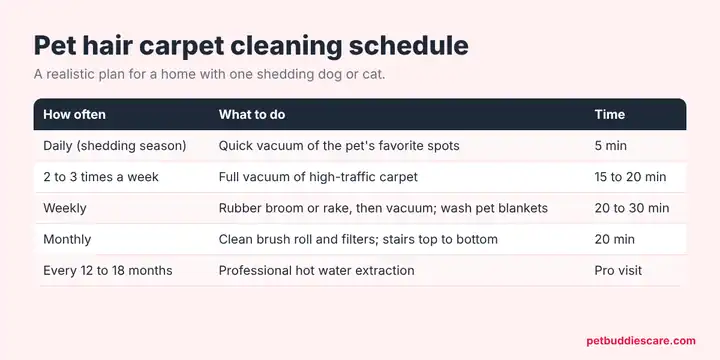
The Carpet and Rug Institute recommends at least once a week, and more often in busy areas. With a shedding pet, vacuum high-traffic carpet two or three times a week, and do a quick daily pass in shedding season.
The Bottom Line
Getting pet hair out of carpet comes down to one idea: loosen it, then lift it. A cheap pair of rubber gloves or a rubber broom pulls up the hair your vacuum can’t, and slow passes in two directions finish the job. Match the tool to your carpet type, keep the brush roll clean, and brush your pet before the fur hits the floor.
Try the rubber glove test tonight on the spot where your pet naps. Once you see what comes up, you’ll never trust a quick vacuum again.
Keep learning: more guides from Pet Buddies Care
- How to remove pet hair from your home: 15 room-by-room tips
- How to get pet hair out of your car
- How to remove pet hair from laundry
Sources: Carpet and Rug Institute (cleaning and maintenance guidance); American College of Allergy, Asthma and Immunology (pet allergies); American Academy of Allergy, Asthma & Immunology (pet allergy and indoor allergens); ASPCA Animal Poison Control (poisonous household products). Updated November 2026. If your pet is shedding much more than usual, check with your vet.
What’s the one tool that finally beat the fur in your house? Tell us in the comments.