
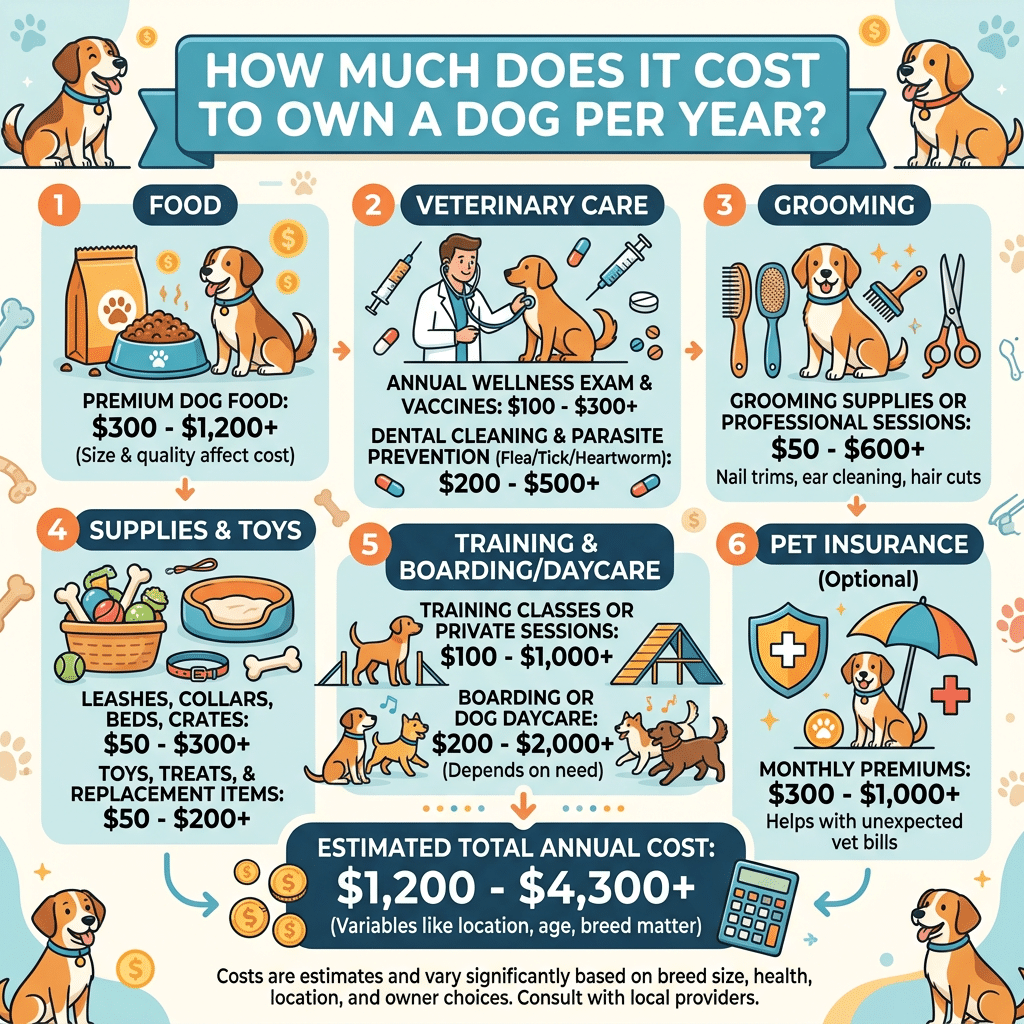
Dog ownership costs $1,200–$4,500 per year in 2026. See the full breakdown by size, age, and state, plus lifetime totals and ways to save.
How Much Does It Cost to Own a Dog Per Year? The Complete 2026 Breakdown
Most people budget for a dog by thinking about food and an annual vet visit. Those are real costs, but they are not the ones that catch owners off guard. The costs that actually strain household budgets are the ones nobody plans for: a $3,500 emergency surgery, $1,200 in boarding fees during a two-week vacation, or the slow accumulation of grooming appointments on a coat type that turned out to need professional maintenance every six weeks.
The headline numbers for 2026: most US dog owners spend between $1,200 and $4,500 per year, with first-year costs running $1,500 to $5,500 because of one-time setup expenses. Over a typical twelve-year lifespan, that totals somewhere between $20,000 and $55,000.
This guide breaks those figures into line items using current data from the ASPCA, AVMA, APPA, Bureau of Labor Statistics, and Rover’s cost reporting. It covers how costs scale with dog size, what changes at each life stage, which expenses vary by state, the emergency scenarios that account for most financial stress, and specific strategies that reduce annual cost without cutting corners on care.
The Headline Figures
| Time Period | Typical Range | Notes |
| First year (including one-time costs) | $1,500–$5,500 | ASPCA estimates $1,391–$4,843 depending on size |
| Ongoing annual cost | $1,200–$4,500 | Rover’s 2025 report: $1,390–$5,295 |
| Lifetime (10 years) | ≈$34,550 | Rover’s 2025 estimate |
| Lifetime (12 years) | $20,000–$55,000 | Blended AVMA, NAPHIA, BLS, Synchrony data |
| The most important statistic in this article ASPCA’s 2026 reporting found that 6 in 10 pet owners do not feel confident they could afford a pet medical emergency. Separately, roughly 1 in 3 pets needs unexpected veterinary care in any given year. Those two figures together explain why most financial distress in dog ownership comes from emergencies, not from routine costs. | ||
First-Year Costs: The Front-Loaded Year
Year one is the most expensive year of a dog’s life by a wide margin, because acquisition and setup costs land all at once alongside puppy-specific veterinary care.
Acquisition
| Source | Cost | What’s Usually Included |
| Shelter adoption | $50–$500 | Often includes spay/neuter, initial vaccines, and microchip |
| Reputable breeder | $1,000–$4,500+ | Puppy only; all veterinary procedures billed separately |
The acquisition decision has a larger downstream effect than the sticker price suggests. Beyond the $600 to $2,600 immediate difference, data on mixed breeds versus purebreds shows that mixed-breed dogs often have fewer breed-specific genetic health conditions, which can translate into lower lifetime veterinary costs. Many shelters also periodically waive fees entirely for senior dogs or long-stay residents.
Initial Setup Supplies
Crate, bed, leash, collar, bowls, toys, and initial grooming tools generally add $500 to $1,500 before the first month is out. This is a category where costs can be substantially reduced through secondhand purchases — crates and carriers in particular hold up well and are widely available used.
Puppy-Specific Veterinary Costs
Puppy medical costs concentrate almost entirely in months one through six. Puppies require three rounds of DAPP vaccines at roughly $60 to $100 per visit, multiple deworming treatments, and spay or neuter surgery typically around six months of age.
| Procedure | Standard Practice | Low-Cost Clinic |
| Spay (female) | $300–$700 | $50–$150 |
| Neuter (male) | $250–$500 | $50–$150 |
| Vaccine series (3 rounds) | $180–$300 | $60–$120 |
| Microchip | $40–$60 | Often included in adoption |
Female spays consistently cost more than male neuters because the surgery is more complex. Low-cost spay and neuter programs run by ASPCA affiliates, humane societies, and county shelters offer the same surgery under the same anesthesia standards at a fraction of general practice pricing.
Early Training
Training costs are also front-loaded. A six-week group obedience class costs $100 to $300, while private training runs $50 to $150 per session. Rover’s 2025 data puts annual training costs for adult dogs at $115 to $290, with higher totals for dogs with behavioral issues.
Annual Recurring Costs: The Line-Item Breakdown
After year one, setup costs disappear and spending settles into a predictable pattern. Here is what a typical medium-sized adult dog costs annually in 2026.
| Category | Annual Range | Notes |
| Food | $300–$1,800 | Scales almost linearly with dog weight |
| Routine veterinary care | $250–$700 | Annual exam, core vaccines, preventatives |
| Flea, tick & heartworm prevention | $150–$400 | 30–60% cheaper through online pharmacies |
| Grooming | $0–$800 | Ranges from zero (short coat, home care) to $700+ (doodle/poodle coats) |
| Pet insurance (optional) | $624–$840 | $52–$70/month average premium |
| Toys, treats & supplies | $100–$300 | Replacement rate varies by chewer intensity |
| Boarding / pet sitting | $0–$1,200 | $25–$85 per night when traveling |
| Licensing & misc. | $20–$100 | Varies by municipality |
Veterinary Inflation Is the Fastest-Rising Category
This deserves particular attention when planning long-term. Bureau of Labor Statistics data shows veterinary services rose 5.3 percent year over year as of early 2026, and are up 55.5 percent since 2019 — the steepest increase of any pet spending category. By comparison, pet food and treats rose only 1.4 percent year over year over the same period.
The practical implication: a dog acquired today will likely cost meaningfully more in veterinary care at age eight than current figures suggest, even adjusting for normal senior-dog cost increases.
How Size Changes Everything
Size is the single biggest driver of cost variation among healthy adult dogs, and the relationship is not what most people expect.
Food Costs Scale Linearly
A 10-pound Chihuahua eats 350 to 500 calories per day, costing roughly $0.80 to $1.50 daily on premium kibble. A 100-pound German Shepherd eats 2,000 to 2,500 calories daily at $2.50 to $5.00. Annualized, that is roughly $300 versus $1,800 — a $1,500 gap that represents the single largest line-item difference between small and large dog ownership.
Veterinary Costs Scale Non-Linearly
This is the part that surprises owners. Large dogs do not just cost more at the vet — they cost disproportionately more. Anesthesia doses scale with body weight. Surgical procedures take longer and consume more materials. Medications cost more at higher dosages.
A concrete example from veterinary cost data: an ACL repair costing approximately $3,500 on a 20-pound dog may run $5,500 on a 100-pound dog. Same procedure, 57 percent more expensive, entirely because of size.
| Dog Size | Annual Cost Range | Primary Cost Drivers |
| Small (under 25 lbs) | $1,000–$2,500 | Lower food and medication costs; often longer lifespan |
| Medium (25–60 lbs) | $1,400–$3,500 | Baseline for most cost estimates |
| Large (60–90 lbs) | $1,800–$4,200 | Higher food, higher surgical costs, larger equipment |
| Giant (90+ lbs) | $2,200–$5,000+ | Highest across every category; shorter lifespan partly offsets lifetime total |
Grooming Varies More Than Size
Grooming is worth separating out because it depends on coat type rather than body size. Short-haired breeds may need nothing beyond occasional home bathing — effectively $0 in professional costs. Doodles, poodles, and other high-maintenance coats typically require professional grooming at $40 to $100 per session every six to eight weeks, which is $260 to $800 annually.
This is a cost that prospective owners frequently overlook when choosing a breed, and it is entirely predictable in advance.
Cost by Life Stage
| Life Stage | Annual Cost | What Drives It |
| Puppy (0–1 year) | $1,500–$5,500 | Acquisition, setup, vaccine series, spay/neuter, training |
| Adult (1–7 years) | $1,200–$3,500 | Steady state: food, routine vet, preventatives, grooming |
| Senior (8+ years) | $1,800–$5,000+ | More frequent vet visits, medications, chronic condition management, $500–$1,000+ in routine care alone |
Senior years frequently cost as much as or more than puppy years, which catches owners who budgeted only for the front-loaded first year. Chronic conditions — arthritis, dental disease, kidney issues, endocrine disorders — often require ongoing medication and more frequent monitoring.
Emergency Costs: The Category That Causes Financial Stress
Routine costs are predictable and manageable. Emergencies are neither, and they are the primary reason dog ownership creates financial difficulty.
| Emergency Type | Typical Cost |
| Minor emergency (wound, ear infection, GI upset) | $800–$1,500 |
| Emergency exam and diagnostics | $280–$1,000 |
| Foreign body / bowel obstruction surgery | $3,000–$5,000 |
| Torn cruciate ligament (ACL) repair | $3,500–$5,500 |
| Major surgery or extended hospitalization | $3,000–$10,000+ |
The Statistics That Matter
Roughly 1 in 3 dogs requires unexpected veterinary care in any given year, according to ASPCA data. And ASPCA and MetLife data both indicate that approximately 60 percent of pet owners say they are not confident they could absorb a large emergency veterinary bill without financial strain.
Those two figures describe a structural mismatch: a common event that most households are not financially prepared for.
Insurance Versus an Emergency Fund
There are two viable approaches, and the right one depends on your situation.
| Approach | Cost | Best For |
| Pet insurance | $52–$70/month ($624–$840/year); reimburses 70–90% after deductible | Owners who cannot absorb a sudden $5,000 bill; breeds with known genetic risks |
| Self-funded emergency savings | $1,500–$3,000 held in reserve | Owners with financial flexibility who can consistently maintain the reserve |
The mathematical argument for insurance is straightforward: one major emergency typically pays for one to two years of premiums. The argument against is that many dogs never have a major emergency, and premiums paid over a decade can exceed the total claims for a healthy dog. The deciding factor is usually not expected value but risk tolerance — specifically, whether a $5,000 bill arriving next month would be a serious problem.
Geographic Variation
Veterinary care, grooming, and pet services vary by up to 20 percent between states. California and New York typically run 15 to 20 percent above the national average, adding roughly $300 to $600 per year for most dogs. Lower-cost states in the Midwest and South run correspondingly below average.
This matters most for owners considering a move, and for anyone comparing cost figures found online — a national average may be substantially off for a specific metro area.
Ten Ways to Reduce Annual Cost Without Cutting Care Quality
1. Use low-cost spay and neuter clinics
ASPCA affiliates, humane societies, and county shelters run subsidized clinics at $50 to $150 versus $300 to $700 at a general practice — the same surgery under the same anesthesia standards. Savings: $250 to $550, one time.
2. Fill prescriptions through online pharmacies
Online pet pharmacies are typically 30 to 60 percent cheaper than in-clinic purchase for the identical prescription. Get the prescription from your vet and fill it online. Savings: $50 to $200 per year.
3. Claim manufacturer rebates on preventatives
Major heartworm and flea/tick brands routinely offer $20 to $60 rebates on six or twelve-dose orders. Most owners never submit them. Savings: $40 to $120 per year.
4. Brush your dog’s teeth daily
Dental disease is the most common chronic condition in dogs, and professional dental cleanings under anesthesia run several hundred dollars per procedure. Daily brushing is close to free and substantially reduces the frequency of professional intervention.
5. Learn basic grooming for maintenance between appointments
Nail trimming, ear cleaning, and brushing are learnable skills. For high-maintenance coats, stretching professional appointments from every six weeks to every ten by maintaining the coat at home saves $200 to $350 annually.
6. Adopt rather than buy
Beyond the $600 to $2,600 acquisition difference, adoption fees typically bundle spay/neuter, initial vaccines, and microchipping — services that would cost $400 to $900 separately.
7. Buy food in larger quantities on subscription
Subscribe-and-save pricing on the same food typically runs 5 to 15 percent below single-bag retail. For a large dog eating $1,500 in food annually, that is $75 to $225.
8. Choose a breed with predictable grooming needs
This is a decision made once, before acquisition, that determines $0 to $800 in annual cost for the next decade. Coat type is entirely predictable in advance.
9. Trade pet sitting with a neighbor or friend
Boarding at $25 to $85 per night is one of the largest discretionary costs for owners who travel. A reciprocal arrangement with another dog owner eliminates it entirely.
10. Invest in training early
A $200 obedience class that prevents destructive chewing pays for itself the first time it saves a pair of shoes, a baseboard, or a section of drywall. Behavioral problems are considerably more expensive to correct later than to prevent early.
A Realistic Sample Annual Budget
Medium-sized adult dog, short coat, moderate lifestyle, no chronic conditions:
| Category | Annual Cost |
| Food (premium kibble, 45 lb dog) | $720 |
| Routine vet (annual exam + vaccines) | $380 |
| Heartworm + flea/tick prevention (online + rebates) | $210 |
| Grooming (home maintenance, occasional professional) | $120 |
| Toys, treats, replacement supplies | $180 |
| Boarding (one 10-day trip per year) | $400 |
| License and miscellaneous | $40 |
| Emergency fund contribution | $600 |
| TOTAL | $2,650 |
Excluding the emergency fund contribution, the operating cost is $2,050 — squarely in the middle of the published range. Including the emergency contribution, the effective annual cost is $2,650, and the owner is building toward the $1,500 to $3,000 reserve that covers most emergency scenarios.
Conclusion
Dog ownership costs $1,200 to $4,500 per year for most American households in 2026, with a first year of $1,500 to $5,500 and a lifetime total between $20,000 and $55,000. Size drives most of the variation among healthy dogs — both through food costs that scale linearly with weight and veterinary costs that scale disproportionately.
The number that should shape planning is not the annual average, though. It is the intersection of two statistics: roughly one in three dogs needs unexpected care each year, and roughly six in ten owners are not confident they could cover a major emergency bill. Whether through insurance at $52 to $70 monthly or a self-funded reserve of $1,500 to $3,000, closing that gap is the single most important financial decision in dog ownership.
Everything else on this list — online pharmacies, rebates, low-cost clinics, home grooming, daily tooth brushing — is optimization worth several hundred dollars a year. Worth doing, but secondary to being prepared for the emergency that statistically arrives about once every three years.
For more pet care guides, product reviews, and practical advice on keeping your dog healthy and happy, visit Pet Buddies Care. You may also find our guides on dog grooming and pet carriers useful when budgeting for these categories. [Internal link: link to your grooming and pet carrier articles]
Frequently Asked Questions
How much does a dog cost per month?
Dividing the typical annual range, most owners spend $100 to $375 per month, with a mid-range figure around $175 to $220 for a medium-sized adult dog. First-year monthly costs are higher because setup and puppy veterinary costs are front-loaded.
What is the most expensive part of owning a dog?
For routine ownership, food and veterinary care are the two largest recurring categories. But the largest single expenses are almost always emergencies — a bowel obstruction surgery or ACL repair costs $3,000 to $5,500, which exceeds an entire year of routine care.
Are small dogs cheaper than large dogs?
Yes, meaningfully. Food costs scale roughly linearly with weight — approximately $300 annually for a 10-pound dog versus $1,800 for a 100-pound dog. Veterinary costs scale even more steeply because anesthesia, medication dosing, and surgical complexity all increase with size. The same ACL surgery can cost 57 percent more on a large dog than a small one.
Is pet insurance worth it for dogs?
It depends on your financial flexibility more than on expected value. Premiums average $52 to $70 monthly and typically reimburse 70 to 90 percent after a deductible. One major emergency generally pays for one to two years of premiums. Given that roughly 1 in 3 dogs needs unexpected care annually and 60 percent of owners could not comfortably absorb a $5,000 bill, insurance makes sense for anyone without a substantial emergency reserve.
How much does a dog cost over its lifetime?
Estimates cluster around $34,550 over ten years, or $20,000 to $55,000 over a typical twelve-year lifespan depending on size, health, and location. Large and giant breeds sit at the upper end; small, healthy, short-coated dogs at the lower end.
What unexpected dog costs should I plan for?
The four most commonly underestimated categories are emergency veterinary care ($800 to $10,000+), boarding or pet sitting while traveling ($25 to $85 per night, meaning $350 to $1,200 for a two-week trip), professional grooming for high-maintenance coats ($260 to $800 annually), and property damage during the puppy stage.
Do dog costs vary by state?
Yes. Veterinary care, grooming, and pet services vary by up to 20 percent between states. California and New York run 15 to 20 percent above national averages, adding $300 to $600 annually for most dogs, while many Midwest and Southern states run below average.
How can I reduce my dog’s annual costs the most?
The three highest-return changes are filling prescriptions through online pharmacies (30 to 60 percent cheaper for identical medication), using low-cost spay/neuter and vaccine clinics, and brushing your dog’s teeth daily to reduce the frequency of professional dental procedures. Together these commonly save $300 to $700 per year without any reduction in care quality.