
An honest comparison of dog DNA test kits — marker counts, breed databases, health screening, accuracy limits, and who each test is actually for.
Dog DNA Test Kits Compared: An Honest Look at Embark, Wisdom Panel, and the Alternatives
If you have a rescue dog labeled “terrier mix” or “lab mix” by a shelter that was guessing, the appeal of a DNA test is obvious. What is less obvious is that these kits differ substantially in what they actually measure, how many genetic markers they read, and — critically — whether they perform real health screening or simply produce a breed pie chart.
This comparison covers the technology behind the tests, what the peer-reviewed research says about accuracy, how the major kits differ on the specifications that matter, and where each one is honestly worth the money. It also covers the limitations that marketing materials tend to leave out, because a $200 test that gives you a confidently wrong answer is worse than no test at all.
How These Tests Actually Work
Every major consumer dog DNA test uses the same underlying technology: SNP microarray. SNP stands for single nucleotide polymorphism — specific points in the genome where individual dogs commonly differ from one another. The array reads your dog’s DNA at a predetermined set of these points.
Why Marker Count Matters
The number of markers a test reads determines its resolution. More points sampled means finer detail — better ability to distinguish between closely related breeds and to detect small ancestry percentages that a lower-resolution test would either miss entirely or lump into a vague category.
Embark scans over 200,000 genetic markers, roughly double what most competing consumer kits check. That density is why it can more reliably separate a Belgian Malinois from a German Shepherd, or distinguish between different bully breed variants, where a lower-density array might blur them together.
Why the Reference Database Matters Equally
Reading markers is only half the process. Your dog’s data then gets compared against a library of verified purebred reference samples. A larger, more diverse library makes it easier to identify uncommon and regional breeds.
Embark’s database was built in partnership with Cornell University’s College of Veterinary Medicine. Wisdom Panel draws on decades of data from Mars Veterinary, one of the largest pet care companies in the world. Both are extensive, but they include different rare and regional breeds, which is why results occasionally differ between the two on the same dog.
| An important nuance most reviews skip A bigger database is not automatically a more accurate one. Accuracy depends on how many purebred reference dogs sit behind each individual breed and how the algorithm assigns your dog’s DNA segments — not simply on the headline breed count. |
What the Research Says About Accuracy
Research published in BMC Genomics examined the accuracy of canine SNP arrays for breed identification, genotyping 909 dogs from 80 breeds using high-density SNP arrays. Breed assignment proved highly reliable under those conditions — but the conditions matter.
Where Accuracy Is Strong
Both major tests are reliable at identifying a dog’s primary breed contributors. Wisdom Panel achieves comparable accuracy to Embark for major breed contributors above roughly 12.5 percent ancestry. For a straightforward “what is my dog mostly made of” question, both platforms deliver.
Where Accuracy Degrades
Breed detection gets measurably fuzzier for small trace percentages — on both platforms. A result reporting 3 percent of some breed should be treated with considerably more skepticism than one reporting 40 percent.
This is where the platforms handle uncertainty differently, and it is worth understanding. Embark states that when a percentage of a dog’s mix does not match any breed in its database, or when a percentage is too small to be confident about, it reports that rather than filling the gap. The concern with any test is that a low-confidence remainder gets assigned to plausible-looking breeds that may or may not actually be present.
Health-marker accuracy depends on the specific variant being read, which is where a denser array provides an advantage. Embark reports accuracy above 99.9 percent for its microarray probes, and its science is backed by the Cornell partnership.
| The honest framing on accuracy This is not a case of one legitimate test versus one questionable test. Both Embark and Wisdom Panel have processed samples from millions of dogs, publish their science, and are routinely recommended by veterinarians and breeders. The differences are real but incremental. |
The Main Comparison
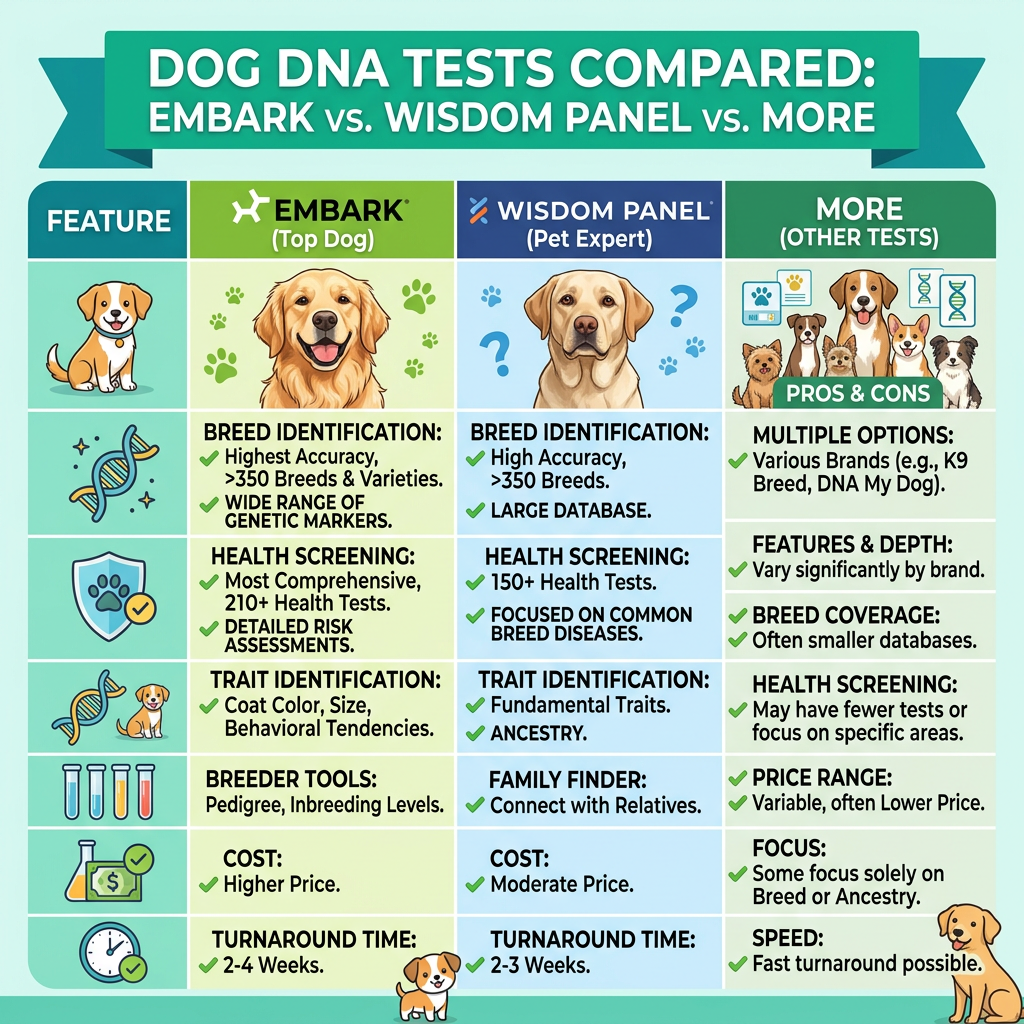
| Specification | Embark | Wisdom Panel | DNA My Dog |
| Genetic markers read | 200,000+ | Fewer (undisclosed exact count) | Substantially fewer |
| Breeds in database | 350–400+ | 350–365+ | Smaller database |
| Health conditions screened | 200–265+ | 25+ (Essential) to 265+ (Premium) | None — no genetic health testing |
| Trait tests | 20+ physical traits | 35–50+ | Limited |
| Wolf / coyote / dingo ancestry | Yes | No | No |
| Village dog ancestry | Yes — only test that does | No | No |
| Relative finder | Yes — patented; 94% of tested dogs find a relative | Yes | No |
| Science partnership | Cornell University College of Veterinary Medicine | Mars Veterinary (decades of data) | — |
| Typical price | $129 (Breed ID) / $139–$199 (Breed + Health) | $99 (Essential) / $159 (Premium) | Lowest tier |
| Turnaround | 2–3 weeks | ~8 days reported in one comparison | Varies |
Embark: The Detailed Case
Where It Genuinely Leads
The marker density advantage is real and it compounds. Two hundred thousand-plus markers — roughly double most competitors — produces better resolution on trace ancestry and better confidence on health variants.
The wild-canine and village dog coverage is genuinely unique. Village dogs are the free-roaming, free-breeding dogs that have lived near human settlements for thousands of years, and they make up an estimated 75 percent of the roughly one billion dogs alive today. For a rescue dog with street-dog ancestry from outside North America and Europe, no other test can properly categorize that ancestry — it gets forced into recognized breed categories where it does not belong.
The Relative Finder uses patented technology to identify genetically related dogs in the database. Embark reports that 94 percent of tested dogs find at least one relative as close as a human first cousin. Whether this is valuable or merely charming depends entirely on your interest level.
The Honest Downsides
Price. Embark’s Breed + Health kit lists at $199, though it is frequently available for $139 to $159 on Embark’s site and on Amazon. That is a meaningful premium over Wisdom Panel’s $99 entry point for what is, for many owners, a marginal accuracy improvement on the primary question of “what breeds is my dog.”
Turnaround is also slower in some comparisons — two to three weeks versus roughly eight days reported for Wisdom Panel in one direct head-to-head.
Worth it for: rescue dogs with unknown or non-Western ancestry, breeding decisions, dogs with unexplained health symptoms, owners who want maximum health screening depth
Wisdom Panel: The Detailed Case
Where It Genuinely Leads
Price-to-value at the entry level is the strongest argument. The Breed Discovery kit at around $99 covers 365-plus breeds and includes the MDR1 drug sensitivity test — which is arguably the single most practically important genetic test for a dog owner, because MDR1 mutation status changes which medications are safe to administer.
The breed database is competitive at 350 to 365-plus breeds, and accuracy for major breed contributors above 12.5 percent ancestry is comparable to Embark. For the core question most owners are asking, the cheaper test answers it about as well.
Wisdom Panel Premium at around $159 brings health screening to 265-plus conditions and 50-plus trait tests, matching Embark’s depth at a lower price point.
The Honest Downsides
The Essential kit’s health screening is limited — 25-plus medical complications versus 200-plus on Embark’s health kit. Buyers frequently do not realize the gap between the entry tier and the premium tier until after purchase.
No wild canine or village dog coverage means street-dog ancestry gets assigned to recognized breeds rather than identified as what it is.
Worth it for: most pet owners on a budget, dogs with likely-Western breed ancestry, owners who primarily want breed identification plus MDR1 status
DNA My Dog and Budget Tests: The Honest Warning
This is the part of the comparison where the honest answer is less comfortable.
DNA My Dog does not perform actual genetic health testing. If you are buying a DNA test because you want to know whether your dog carries risk variants for hereditary conditions, budget tests in this category will not answer that question regardless of what the packaging implies.
The breed identification from lower-marker-count tests is also correspondingly lower resolution. For a dog with two clear parent breeds, a budget test may get the primary answer approximately right. For a genuinely mixed dog with four or five contributing breeds, the resolution is often insufficient to produce a trustworthy breakdown.
| The clearest recommendation in this article If health screening matters to you at all, the budget tier is not a cheaper version of the same product — it is a different product that does not do health screening. Step up to any Embark or Wisdom Panel option, or skip testing entirely and put the money toward a veterinary consultation. |
Specialized Options Worth Knowing About
The Embark Dog Age Test
A genuinely different category of test. Rather than identifying breeds or screening health, it uses DNA methylation technology to estimate a dog’s age and predict a likely birthday. It exists to fill a specific gap: rescue dogs whose age was estimated by a shelter with no real information.
Whether this is worth buying depends entirely on whether age uncertainty actually affects decisions you are making. For senior care planning it can be genuinely useful; for curiosity alone it is an expensive answer.
ORIVET
Positioned around $99 with 365-plus breeds and 265 health markers plus a personalized life plan — competitive on paper with the premium tiers at the budget price point, though with less independent validation coverage than the two market leaders.
What These Tests Cannot Tell You
An honest comparison has to include the limitations, because the marketing rarely does.
A Health Risk Variant Is Not a Diagnosis
Carrying a risk variant for a condition means elevated statistical risk, not that your dog has or will develop the condition. Many variants are recessive, meaning a single copy has no health consequence at all. Results should be discussed with a veterinarian rather than acted on independently.
Breed Does Not Predict Behavior Reliably
A common motivation for testing is explaining behavior — why the dog digs, barks, herds, or guards. Breed ancestry provides weak predictive power for individual behavior. Environment, training, socialization, and individual temperament account for far more variance than breed percentage.
Trace Percentages Are the Weakest Output
The 2 to 5 percent entries at the bottom of a breed breakdown are where every platform is least reliable. Treat the top two or three contributors as reasonably solid and the tail as approximate.
Results Can Differ Between Platforms
Because the two major companies use different reference databases with different rare and regional breed coverage, the same dog can produce somewhat different breakdowns on each. This is not evidence that one is wrong — it reflects genuine differences in reference libraries.
The Testing Process: What Actually Happens
Worth knowing before you buy, because the practical experience is nearly identical across brands and it is simpler than most people expect.
Collecting the Sample
Every major kit uses a cheek swab rather than blood. You rotate a swab against the inside of your dog’s cheek for roughly 30 to 60 seconds, collecting cells from the cheek lining. The whole process takes under two minutes per dog, and most dogs tolerate it with minimal fuss.
The one procedural detail that causes most failed samples: your dog should not have eaten, drunk, or chewed anything for at least 30 to 60 minutes beforehand, and dogs in multi-dog households should be separated during collection to avoid cross-contamination from shared water bowls or mutual grooming.
Return and Processing
Kits include a pre-paid return mailer — you drop it in a mailbox. Both major companies send confirmation when the sample arrives at the lab, and again when results are ready. Embark typically returns results in two to three weeks; one direct comparison reported Wisdom Panel results roughly eight days after arrival.
What the Report Contains
Breed breakdown by percentage is the headline. Beyond that, reports typically include a family tree tracing composition back through prior generations, physical trait explanations (coat type, shedding, size prediction), and — on health-inclusive kits — a list of screened conditions with your dog’s status on each: clear, carrier, or at risk.
What to Actually Do With Your Results
This section exists because most owners get results, look at the pie chart, and never use the information again — which wastes most of what they paid for.
Share Health Results With Your Veterinarian
This is the highest-value action, and most owners skip it. A single result worth flagging above all others: MDR1 drug sensitivity status. Dogs carrying the MDR1 mutation can have severe adverse reactions to several common medications, including certain parasite treatments and anesthetics. Knowing this before an emergency surgery rather than during one is the clearest practical benefit any of these tests provide.
Adjust Preventive Care to Documented Breed Risks
If your dog’s breakdown shows significant ancestry from breeds with known predispositions — hip dysplasia in larger breeds, cardiac conditions in certain lines, eye conditions in others — that is a reasonable prompt to discuss earlier or more frequent screening with your vet, not a reason for alarm.
Use Weight and Size Predictions for Puppies
For a mixed-breed puppy, adult size prediction is genuinely practical information. It affects crate sizing, food quantity budgeting, and whether the apartment you are about to sign a lease on has a weight limit that will become a problem in eight months.
Recalibrate Exercise Expectations, Cautiously
Breed ancestry provides weak behavioral prediction, but energy requirements track somewhat more reliably than temperament. A dog with substantial working or herding breed ancestry plausibly needs more structured activity than one from primarily companion breeds. Treat this as a hypothesis to test rather than a rule.
Which Test for Which Owner
| Your Situation | Recommended | Reasoning |
| Budget-conscious, want breed ID + MDR1 | Wisdom Panel Breed Discovery (~$99) | Covers the practically important drug sensitivity test at the lowest credible price |
| Rescue dog, unknown or international origin | Embark Breed + Health | Only test covering village dog, wolf, coyote, and dingo ancestry |
| Want maximum health screening | Embark Breed + Health or Wisdom Panel Premium | 200–265+ conditions on either; compare current pricing |
| Dog has unexplained recurring health issues | Embark Breed + Health | Denser array, Cornell-backed variant science; bring results to your vet |
| Rescue dog with genuinely unknown age | Embark Dog Age Test | Only consumer test using DNA methylation for age estimation |
| Purely curious, no health concern | Wisdom Panel Essential | Lowest credible-tier cost for a breed answer |
| Considering breeding | Embark Breed + Health | Health variant depth matters most in this scenario; also consult a veterinary geneticist |
Conclusion
Both market leaders are legitimate products backed by real science. Embark reads roughly twice the genetic markers, partners with Cornell’s veterinary college, uniquely covers village dog and wild canine ancestry, and generally leads on health screening depth. Wisdom Panel delivers comparable breed accuracy for major contributors at a meaningfully lower entry price and includes the practically important MDR1 test even in its budget tier.
For most pet owners asking a simple breed question, the $99 Wisdom Panel option answers it about as well as the $139 to $199 Embark option. For rescue dogs of uncertain or non-Western origin, for health screening depth, or for anything approaching a clinical question, the additional marker density and health panel on Embark are worth the premium.
The one recommendation this comparison makes without hedging: if health screening is part of why you are testing, avoid the budget tier entirely. DNA My Dog does not perform genetic health testing, and buying it expecting health information means buying the wrong product.
For more pet care guides, honest product comparisons, and dog health information, visit Pet Buddies Care. Our guide on the annual cost of owning a dog covers where DNA testing fits into a realistic pet budget. [Internal link: link to your dog cost article and grooming guides]
Frequently Asked Questions
Which dog DNA test is the most accurate?
Embark is generally considered the most accurate available to consumers, analyzing over 200,000 genetic markers — roughly double most competitors — and reporting accuracy above 99.9 percent for its microarray probes. Wisdom Panel is a close second at a lower price, and achieves comparable accuracy for major breed contributors above 12.5 percent ancestry.
Is Embark worth the extra money over Wisdom Panel?
It depends on your dog and your question. For a straightforward breed reveal on a likely-Western mixed dog, Wisdom Panel’s $99 kit answers it about as well. Embark’s premium is worth it for rescue dogs with unknown or international ancestry, for maximum health screening depth, or when you have a specific health concern to investigate.
Do cheap dog DNA tests work?
For rough breed identification on simple mixes, somewhat. For health screening, no — DNA My Dog does not perform genetic health testing at all. Lower marker counts also mean lower resolution on complex mixes, so a genuinely mixed dog may get an unreliable breakdown.
How long do dog DNA test results take?
Typically two to three weeks for Embark. One direct comparison reported results from Wisdom Panel in roughly eight days after sample arrival. Both send confirmation when your sample reaches the lab.
Why did two DNA tests give different results for my dog?
Because the companies use different reference databases with different coverage of rare and regional breeds, and different algorithms for assigning DNA segments. Differences are most pronounced on small trace percentages, where all platforms are least reliable. The primary breed contributors usually agree closely.
Can a DNA test tell me my dog’s personality or behavior?
Not reliably. Breed ancestry has weak predictive power for individual behavior. Environment, training, socialization, and individual temperament account for considerably more variance than breed percentage. Treat behavioral inferences from breed results as loose tendencies, not predictions.
Should I act on health results from a DNA test?
Not without veterinary input. Carrying a risk variant means elevated statistical risk, not a diagnosis, and many variants are recessive with no health consequence in a single copy. Bring the report to your veterinarian for interpretation in the context of your dog’s actual clinical picture.
What is village dog ancestry and why does it matter?
Village dogs are the free-roaming, free-breeding dogs that have lived alongside humans for thousands of years, estimated to make up about 75 percent of the world’s roughly one billion dogs. Embark is the only consumer test that identifies this ancestry. Without it, a street-dog-descended rescue gets its ancestry forced into recognized breed categories where it may not genuinely belong.