
How Much Does It Cost to Own a Dog Per Year? (2026)
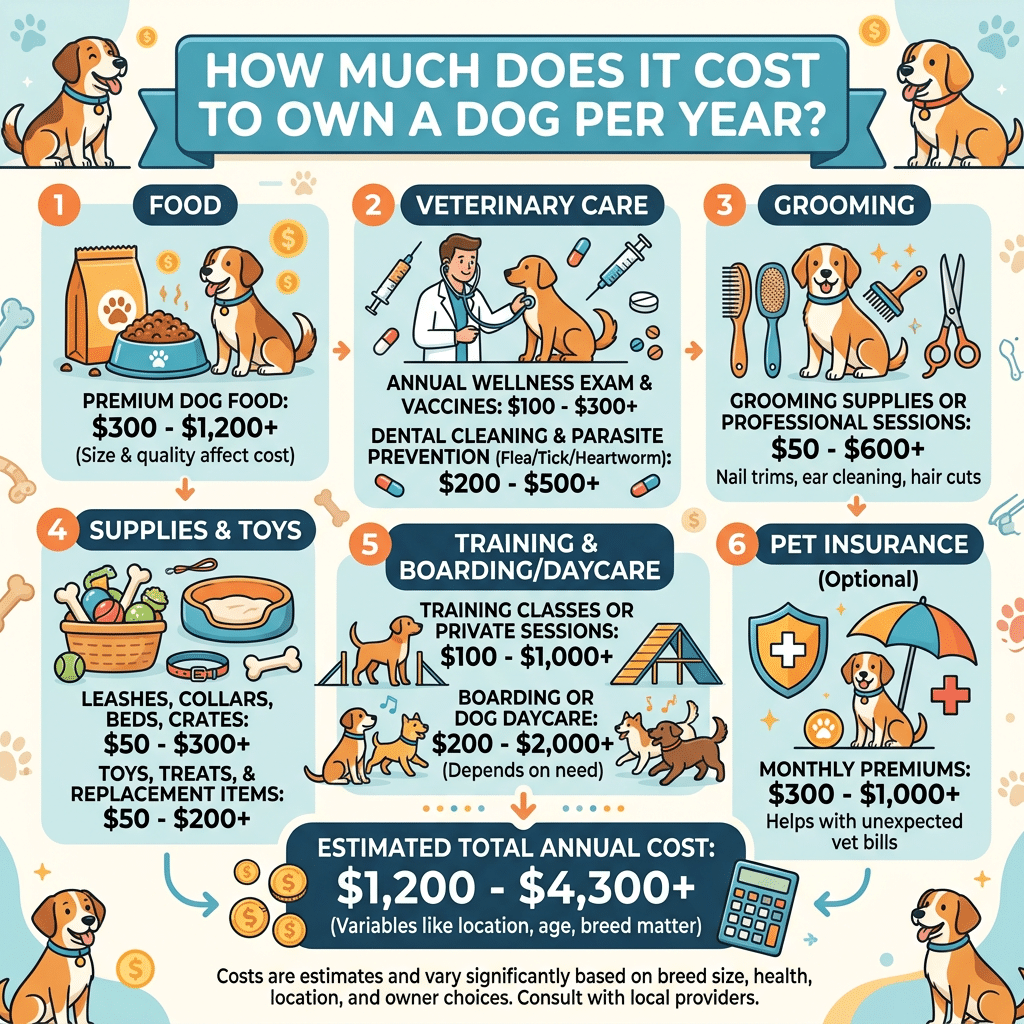
Dog ownership costs $1,200–$4,500 per year in 2026. See the full breakdown by size, age, and state, plus lifetime totals and ways to save. How Much Does It Cost to Own a Dog Per Year? The Complete 2026 Breakdown Most people budget for a dog by thinking about food and an annual vet visit. Those are real costs, but they are not the ones that catch owners off guard. The costs that actually strain household budgets are the ones nobody plans for: a $3,500 emergency surgery, $1,200 in boarding fees during a two-week vacation, or the slow accumulation of grooming appointments on a coat type that turned out to need professional maintenance every six weeks. The headline numbers for 2026: most US dog owners spend between $1,200 and $4,500 per year, with first-year costs running $1,500 to $5,500 because of one-time setup expenses. Over a typical twelve-year lifespan, that totals somewhere between $20,000 and $55,000. This guide breaks those figures into line items using current data from the ASPCA, AVMA, APPA, Bureau of Labor Statistics, and Rover’s cost reporting. It covers how costs scale with dog size, what changes at each life stage, which expenses vary by state, the emergency scenarios that account for most financial stress, and specific strategies that reduce annual cost without cutting corners on care. The Headline Figures Time Period Typical Range Notes First year (including one-time costs) $1,500–$5,500 ASPCA estimates $1,391–$4,843 depending on size Ongoing annual cost $1,200–$4,500 Rover’s 2025 report: $1,390–$5,295 Lifetime (10 years) ≈$34,550 Rover’s 2025 estimate Lifetime (12 years) $20,000–$55,000 Blended AVMA, NAPHIA, BLS, Synchrony data The most important statistic in this article ASPCA’s 2026 reporting found that 6 in 10 pet owners do not feel confident they could afford a pet medical emergency. Separately, roughly 1 in 3 pets needs unexpected veterinary care in any given year. Those two figures together explain why most financial distress in dog ownership comes from emergencies, not from routine costs. First-Year Costs: The Front-Loaded Year Year one is the most expensive year of a dog’s life by a wide margin, because acquisition and setup costs land all at once alongside puppy-specific veterinary care. Acquisition Source Cost What’s Usually Included Shelter adoption $50–$500 Often includes spay/neuter, initial vaccines, and microchip Reputable breeder $1,000–$4,500+ Puppy only; all veterinary procedures billed separately The acquisition decision has a larger downstream effect than the sticker price suggests. Beyond the $600 to $2,600 immediate difference, data on mixed breeds versus purebreds shows that mixed-breed dogs often have fewer breed-specific genetic health conditions, which can translate into lower lifetime veterinary costs. Many shelters also periodically waive fees entirely for senior dogs or long-stay residents. Initial Setup Supplies Crate, bed, leash, collar, bowls, toys, and initial grooming tools generally add $500 to $1,500 before the first month is out. This is a category where costs can be substantially reduced through secondhand purchases — crates and carriers in particular hold up well and are widely available used. Puppy-Specific Veterinary Costs Puppy medical costs concentrate almost entirely in months one through six. Puppies require three rounds of DAPP vaccines at roughly $60 to $100 per visit, multiple deworming treatments, and spay or neuter surgery typically around six months of age. Procedure Standard Practice Low-Cost Clinic Spay (female) $300–$700 $50–$150 Neuter (male) $250–$500 $50–$150 Vaccine series (3 rounds) $180–$300 $60–$120 Microchip $40–$60 Often included in adoption Female spays consistently cost more than male neuters because the surgery is more complex. Low-cost spay and neuter programs run by ASPCA affiliates, humane societies, and county shelters offer the same surgery under the same anesthesia standards at a fraction of general practice pricing. Early Training Training costs are also front-loaded. A six-week group obedience class costs $100 to $300, while private training runs $50 to $150 per session. Rover’s 2025 data puts annual training costs for adult dogs at $115 to $290, with higher totals for dogs with behavioral issues. Annual Recurring Costs: The Line-Item Breakdown After year one, setup costs disappear and spending settles into a predictable pattern. Here is what a typical medium-sized adult dog costs annually in 2026. Category Annual Range Notes Food $300–$1,800 Scales almost linearly with dog weight Routine veterinary care $250–$700 Annual exam, core vaccines, preventatives Flea, tick & heartworm prevention $150–$400 30–60% cheaper through online pharmacies Grooming $0–$800 Ranges from zero (short coat, home care) to $700+ (doodle/poodle coats) Pet insurance (optional) $624–$840 $52–$70/month average premium Toys, treats & supplies $100–$300 Replacement rate varies by chewer intensity Boarding / pet sitting $0–$1,200 $25–$85 per night when traveling Licensing & misc. $20–$100 Varies by municipality Veterinary Inflation Is the Fastest-Rising Category This deserves particular attention when planning long-term. Bureau of Labor Statistics data shows veterinary services rose 5.3 percent year over year as of early 2026, and are up 55.5 percent since 2019 — the steepest increase of any pet spending category. By comparison, pet food and treats rose only 1.4 percent year over year over the same period. The practical implication: a dog acquired today will likely cost meaningfully more in veterinary care at age eight than current figures suggest, even adjusting for normal senior-dog cost increases. How Size Changes Everything Size is the single biggest driver of cost variation among healthy adult dogs, and the relationship is not what most people expect. Food Costs Scale Linearly A 10-pound Chihuahua eats 350 to 500 calories per day, costing roughly $0.80 to $1.50 daily on premium kibble. A 100-pound German Shepherd eats 2,000 to 2,500 calories daily at $2.50 to $5.00. Annualized, that is roughly $300 versus $1,800 — a $1,500 gap that represents the single largest line-item difference between small and large dog ownership. Veterinary Costs Scale Non-Linearly This is the part that surprises owners. Large dogs do not just cost more at the vet — they cost disproportionately more. Anesthesia doses scale with body weight. Surgical procedures take longer and consume more materials. Medications cost more at higher dosages. A concrete example from veterinary cost data: an ACL repair
How Much Does It Cost to Own a Dog Per Year? (2026) Read More »