
The best airtight dog food container is one big enough to hold the whole bag, with a gasket lid that seals tight and a body you can wash between bags. Keep the kibble inside its original bag, set the bag in the bin, and store it somewhere cool and dry, below 80°F.
That sounds simple, but most people do it the other way. They tip a fresh 30-pound bag into a bin, toss the empty bag, and keep topping up the same container for months. A few weeks later the kibble smells a little off, the dog gets picky, and nobody knows the lot number when a recall hits the news.
This guide fixes all of that. You’ll learn why “bag in” beats “pour in,” exactly what size container fits your bag, where to keep it, how long food really stays fresh, and which containers are worth buying.
This post contains affiliate links. We may earn a small commission at no extra cost to you. See our Disclosure. Capacities come from product listings and prices change, so check the current listing.
🥫 Quick Answer: How to Use an Airtight Dog Food Container
- Bag in, not pour in: put the whole clipped bag inside the bin. The FDA recommends this so the lot number and best-by date stay with the food.
- Size up: choose a container rated for more pounds than your bag. A 30 lb bag usually needs a 40 lb bin.
- Cool and dry: store it below 80°F, away from the stove, sun and a hot garage.
- Use it up: finish an opened bag of dry food in about 4 to 6 weeks.
- Wash between bags: hot soapy water, then dry it completely.
In this guide
Why an Airtight Dog Food Container Matters
An airtight container protects kibble from the four things that ruin it: air, heat, moisture and pests. Dry dog food is baked and then coated with fat for flavor. Once the bag is open, oxygen starts breaking down those fats. Whole Dog Journal explains that air exposure speeds up fat oxidation, which makes food go rancid, and humidity can let mold grow.
You can’t always see it happening. Rancid kibble often looks normal. The first clue is usually your dog, who sniffs the bowl and walks away. Vitamins break down too, so the food on day 40 isn’t quite the food you paid for on day 1.
Then there are the uninvited guests. Picture a laundry room in July: the bag is rolled shut with a chip clip, there’s a tiny gap at one corner, and by morning there’s a trail of ants marching straight in. A sealed bin stops that. It also stops the clever Lab who has figured out that a paper bag is just a box with a soft side.
So the container matters. But how you use it matters even more, and that’s where most people slip.
Bag In or Pour In? What the FDA Recommends
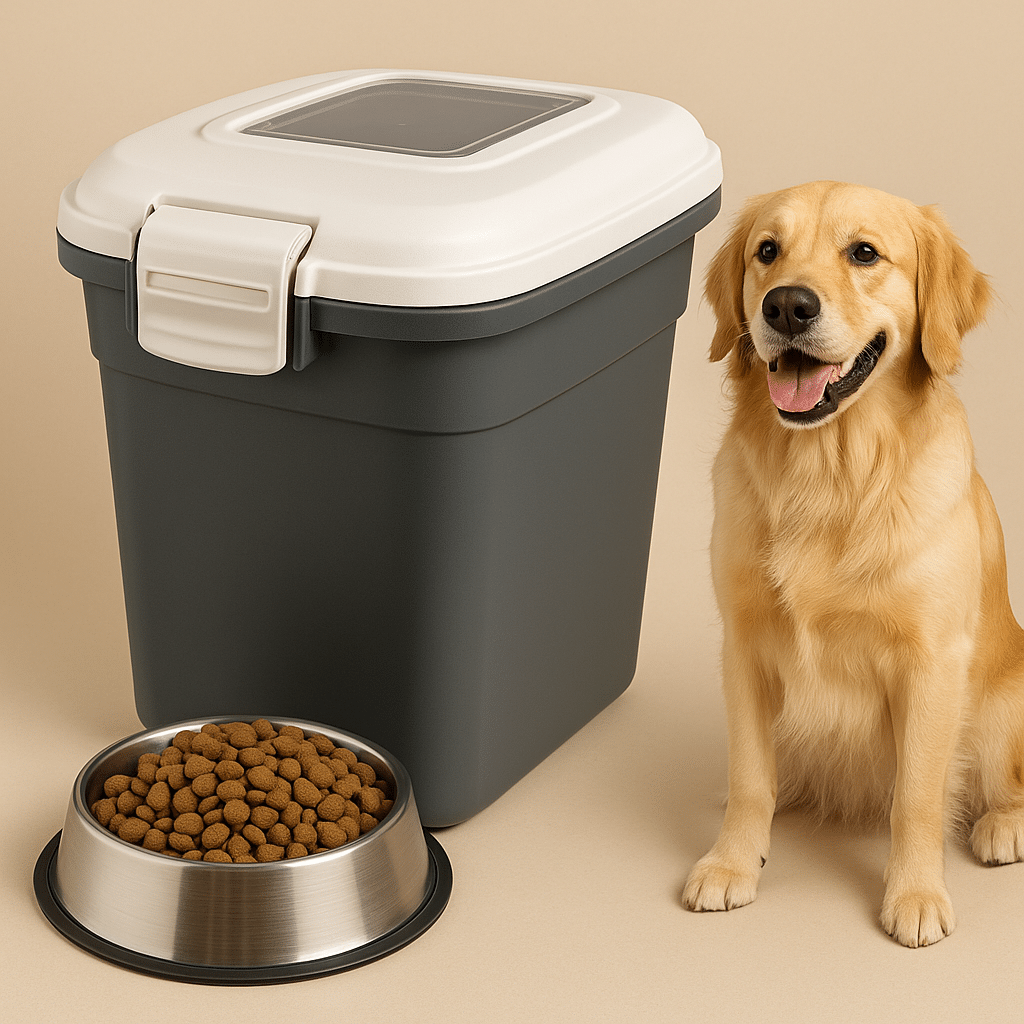
Keep the food in its original bag and put the whole bag inside the container. That’s the FDA’s advice in its guide to proper storage of pet food and treats. The bag carries the UPC, lot number, manufacturer and best-by date, which you’ll need if the food is ever recalled or your dog gets sick.
There’s a freshness reason too. Pet food bags are built as a barrier against fat and oxygen. A plastic bin isn’t. When you pour kibble straight in, a film of fat and crumbs coats the walls. Top it up with a new bag and that old, stale fat mixes into the fresh food. A vet-reviewed WebMD guide to dog food storage containers gives the same advice: keep the food in its bag and put the bag in the container.
Prefer to pour? That’s OK if you do it right. The FDA says the container should be clean, dry and have a snug lid. Save the label details (tape the cut-out label to the lid or snap a photo), and wash and dry the bin before every new bag.
| Method | Freshness | Recall info | Verdict |
|---|---|---|---|
| 🟢 Bag inside an airtight bin | Best: bag lining plus sealed lid | Stays on the bag | Best choice |
| 🟡 Pour into a clean bin | Good if washed every refill | Lost unless you save the label | OK with care |
| 🔴 Open bag with a clip | Fair; air and humidity get in | Kept | Pest and dog risk |
| 🔴 Topping up an unwashed bin | Poor; old fat mixes with new food | Mixed lots | Avoid |
Based on FDA pet food storage guidance.
What Size Dog Food Container Do You Need?
Buy a container rated for more pounds than your bag holds. Capacity ratings assume loose kibble, but a bag has folds, air and a rolled top, so it takes up more room. As a rule of thumb, size up by about a third.
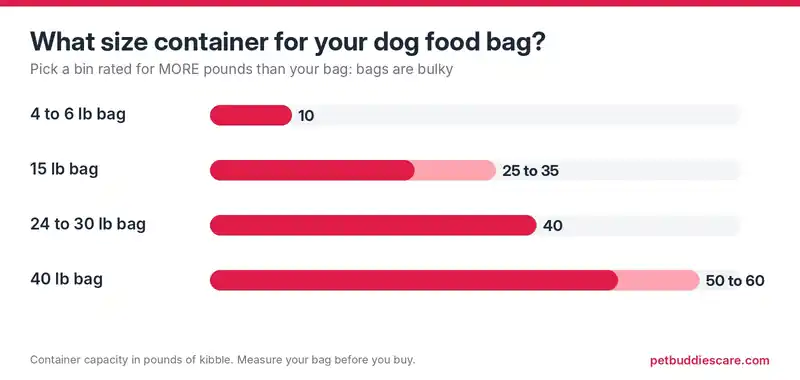
| Your bag | Container to look for | Example sizes | Good for |
|---|---|---|---|
| 🐕 4 to 6 lb | Up to 10 lb | IRIS WeatherPro 10 lb | Toy dogs, treats, cat food |
| 🐕 15 lb | 25 to 35 lb | Vittles Vault 35 lb | Small dogs |
| 🐕 24 to 30 lb | 40 lb | IRIS WeatherPro 40 lb | Medium dogs |
| 🐕 40 lb | 50 to 60 lb | IRIS 50 lb, Vittles Vault 60 lb | Large dogs, multi-dog homes |
Rule of thumb from product capacity listings. Measure your bag (height, width, depth) before you buy.
Here’s a real-life check. Say you feed a 50-pound mixed breed about 3 cups a day. A 30-pound bag lasts roughly a month, which fits the 4-to-6-week freshness window nicely. If you buy a 40-pound bag to save money but it takes 8 weeks to finish, the last few weeks of food are past their best. Bigger isn’t always cheaper once you count the food your dog refuses.
Watching your budget? Our breakdown of how much a dog costs per year shows how food fits into the full yearly cost.
What to Look for in an Airtight Dog Food Container
Now that you know the size, the details decide whether a container keeps food fresh or just keeps it out of sight.
- A real seal. Look for a rubber or silicone gasket plus latches, or a screw-on lid. A lid that simply rests on top is not airtight.
- Food-safe material. Choose BPA-free, food-grade plastic, stainless steel or glass. WebMD notes that stainless steel containers are never made with BPA.
- A wide opening. You should be able to lift the bag in and out and scoop without a fight.
- Easy to clean. Smooth inside corners, no deep grooves, and a size that fits your sink or tub.
- Wheels for big bins. A full 40 lb bin is heavy. Removable wheels let you roll it out to clean behind it.
- Dog-proof latches. If your dog has ever opened a cupboard, pick locking latches or a screw lid.
- See-through body (optional). A translucent bin shows you when it’s time to buy more.
Best Airtight Dog Food Containers
These picks are based on official specs, capacity listings and long-running owner review patterns. We haven’t run lab tests on them, so treat this as a shortlist and check the current listing for size and price.
| Container | Seal type | Sizes | Best for |
|---|---|---|---|
| IRIS USA WeatherPro | Gasket lid + snap latches | 6.5 to 50 lb | Best all-around, rolling bin |
| Gamma2 Vittles Vault | Screw-on Gamma Seal lid | 10–15 to 60 lb | Humid homes, ants, mice |
| IRIS combo sets | Gasket lid + latches | 30 lb + small bin | Two pets, or food plus treats |
| Small canisters (e.g. OXO Pet POP) | Push-button seal | About a week of food | Treats, toy dogs, countertop |
1. IRIS USA WeatherPro Airtight Container (best all-around)
A translucent bin with a gasket lid, snap latches and removable wheels, so you can see how much is left and roll it away from the wall. It comes in sizes from 6.5 lb up to 50 lb. The wide opening works for scooping, and the larger models hold a full bag inside. Skip it if you need it to fit under a low shelf; the bigger sizes are tall.

- FOOD FOR ALL: Store your cute family member's dry foods into sealable and portable pet food container. This airtight foo…
- AIRTIGHT CONTAINER: Ensure your pet's food stays fresh with airtight seals and snap-lock latches, keeping moisture and h…
- CLEAR CONTAINER BODY: The translucent body allows you to check the food level in just one glance. Quickly check the rema…

- FOOD FOR ALL: For your cats, dogs, birds, and more. Store your cute family member's dry foods into sealable and portable…
- AIRTIGHT CONTAINER: Ensure your pet's food stays fresh with our airtight seals and snap-lock latches, keeping moisture a…
- TRANSLUCENT BODY: See-through plastic allows you to check the food levels at a glance. Tapered shape from top to bottom;…

- FOOD FOR ALL: Store your cute family member's dry foods into sealable and portable pet food container. 65 Qt size food s…
- AIRTIGHT CONTAINER: Ensure your pet's food stays fresh with our airtight seals and snap-lock latches, keeping moisture a…
- ROLL IT AROUND: The storage bins come with attachable casters, so you have the option to have them off or on. Store it o…

- FOOD FOR ALL: Store your cute family member's dry foods into sealable and portable pet food container. This airtight foo…
- AIRTIGHT CONTAINER: Ensure your pet's food stays fresh with airtight seals and snap-lock latches, keeping moisture and h…
- CLEAR CONTAINER BODY: The translucent body allows you to check the food level in just one glance. Quickly check the rema…
2. Gamma2 Vittles Vault (best seal for pests and humidity)
A heavy-duty, made-in-USA bin with a screw-on Gamma Seal lid that closes with a few turns. It suits damp climates, ant-prone kitchens and garages where mice are a worry. Sizes run from 10 to 15 lb up to 60 lb, and the stackable versions put the lid at the front so you can reach food without unstacking. Skip it if twisting a lid is hard on your hands.

- PRESERVE FRESHNESS AND FLAVOR: This airtight pet food container helps your pet's dry food to stay tasty with its Gamma S…
- PROTECT FROM PESTS: The sealed lid of this dog food container locks in flavor and pet food smells while keeping out pest…
- SAFE AND DURABLE STORAGE: Made from food-grade HDPE plastic, this dog food storage container with a 35 lbs capacity prov…

- PRESERVE FRESHNESS AND FLAVOR: This airtight pet food container helps your pet's dry food to stay tasty with its Gamma S…
- PROTECT FROM PESTS: The sealed lid of this dog food container locks in flavor and pet food smells while keeping out pest…
- SAFE AND DURABLE STORAGE: Made from food-grade HDPE plastic, this dog food storage container with a 50 lbs capacity prov…

- PRESERVE FOOD FLAVOR AND FRESHNESS: Pet food is expensive. Don't let it go stale. Our pet food container uses Gamma Seal…
- SAY GOODBYE TO PESKY PESTS: In addition to locking in flavor and pet food smells, Gamma Seal Technology keeps ants and o…
- FOOD-SAFE AND BPA-FREE: The Vittles Vault dog and cat food storage container is made from food-grade, durable, BPA-free …
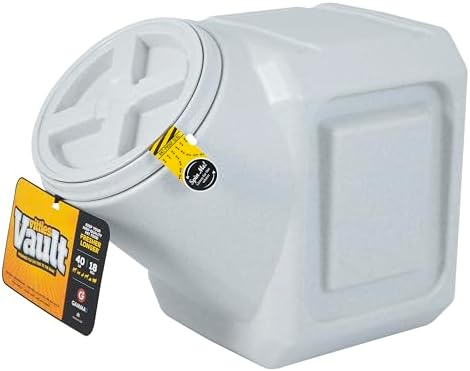
- Airtight Food Storage Container: This pest-proof pet food container for dry food keeps food fresh with our patented airt…
- Heavy Duty BPA-Free HDPE Plastic: Can be kept in garages, barns and outdoors; Perfect for dry food, treats, birdseed and…
- Airtight Engineering: Our Gamma Seal technology makes for a controlled moisture balance and features a threaded locking …

- SAVE SPACE AND PRESERVE FLAVOR: The stackable dog food bin containers optimize storage while keeping pet food fresher fo…
- SAY GOODBYE TO PESKY PESTS: Gamma Seal Technology protects your pet's food by locking in moisture and keeping ants and p…
- FOOD-SAFE TECHNOLOGY: Crafted from durable, food-grade plastic, durable, HDPE pet food container provides safe storage o…
3. IRIS Combo Sets (best for multiple pets or treats)
These sets pair a large wheeled bin (up to 30 lb) with a smaller container for treats or cat food, and include a 2-cup scoop. One version adds a slow-feeder bowl. The small bin stacks on the big one, so everything stays in one corner. Handy if you bake homemade dog treats and need somewhere to keep them.

- COMPLETE PET FEEDING SOLUTION: This set includes an airtight dog food storage container that holds up to 30 lbs of food …
- AIRTIGHT CONTAINER: Ensure your pet's food stays fresh with airtight seals and snap-lock latches, keeping moisture and h…
- DESIGNED FOR SAFETY AND CONVINIENCE: The anti-slip, short snouted bowl is perfect for flat-faced breeds, ensuring a comf…

- AIRTIGHT CONTAINER: Ensure your pet's food stays fresh with airtight seals and snap-lock latches, keeping moisture and h…
- CONTENTS: 11 lbs / 12 Qt storage container securely stacks on the 30 lbs / 33 Qt storage container, one matching 2-cup f…
- CLEAR CONTAINER BODY: The translucent body allows you to check the food level at just one glance. Quickly assess the rem…
4. More Good Options
These styles are also worth a look. Specs change by model, so compare capacity and lid type on the listing.
- Van Ness 25 lb container: a budget snap-lid bin with a gasket.
- Buddeez Roll Away: a rolling bin designed to hold the whole bag, with a pour spout and scoop.
- Bergan Smart Storage: stackable sizes for multi-pet homes.
- OXO Good Grips Pet POP: a small push-button canister for a week of kibble or treats.
- Metal storage tins: stylish, rodent-proof and easy to wash, best for small amounts.
A great container only works if it lives in the right spot, so let’s talk about where to put it.
Where to Store Dog Food (and Where Not To)
Store dry dog food in a cool, dry place where the temperature stays below 80°F. The FDA warns that too much heat or moisture can make nutrients break down. A pantry or closet is ideal. A garage in Texas in August is not.
| Spot | OK? | Why |
|---|---|---|
| 🟢 Pantry or hall closet | Yes | Cool, dark and dry all year |
| 🟢 Laundry room or mudroom | Yes, if dry | Keep the bin off a damp floor and away from the dryer vent |
| 🟡 Basement | Maybe | Only with a sealed bin and low humidity |
| 🔴 Garage or shed | Usually no | Summer heat and pests; fine only if climate-controlled |
| 🔴 Next to the stove, oven or dishwasher | No | Heat and steam speed up spoilage |
| 🔴 Sunny window or car trunk | No | Sun and heat turn fats rancid fast |
The FDA recommends storing dry pet food below 80°F in a cool, dry place.
Here’s the catch with garages. In winter they seem perfect: cold and roomy. Then a heat wave hits, the inside of a closed garage climbs well past 80°F, and a month of kibble bakes a second time. If the garage is your only option, use a screw-lid bin, keep it off the floor, and move it indoors for summer.
How to Store Dog Food Step by Step
This whole routine takes about two minutes per bag.
- Check the best-by date at the store. Pick the bag with the latest date.
- Photograph the label (brand, lot number, best-by date) when you open it.
- Roll the top down tight and clip it, pushing out as much air as you can.
- Set the whole bag inside the container and close the latches or screw the lid fully.
- Store it in a cool, dry spot below 80°F.
- Use a clean, dry scoop that’s only used for pet food. The FDA says to wash scoops and bowls after each use.
- When the bag is empty, wash the container with hot soapy water, rinse and let it dry completely before the next bag.
✅ New-Bag Checklist
- ☐ Best-by date checked
- ☐ Label photo saved
- ☐ Bin washed and fully dry
- ☐ Bag clipped and placed inside
- ☐ Lid latched or screwed shut
- ☐ Bin in a cool, dry spot
How Long Does Dry Dog Food Last?
An unopened bag of kibble usually stays good for 12 to 18 months, and once opened you should finish it within about 4 to 6 weeks, according to Whole Dog Journal’s shelf-life guide. Always go by the best-by date on your bag, since it’s based on when that batch was made.
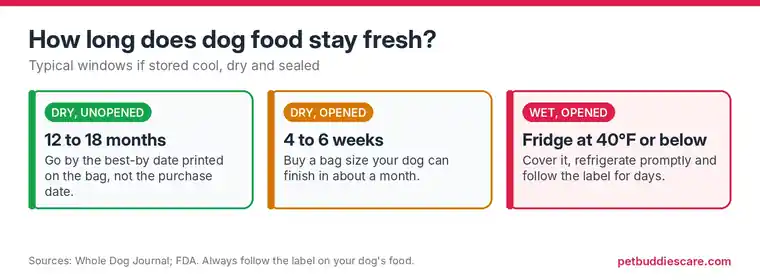
Wet food is different. Once a can or pouch is open, the FDA says to refrigerate leftovers promptly or throw them out, with your fridge at 40°F or below. Cover the can with a lid, and follow the label for how many days it keeps.
What about treats? Store them the same way: sealed, cool and dry. Homemade treats spoil much faster than store-bought ones because they don’t have preservatives, so keep them in the fridge or freezer.
Signs Your Dog’s Food Has Gone Bad
Trust your nose first. Fresh kibble smells like, well, kibble. Spoiled food usually gives itself away with one of these signs:
- A sour, stale or paint-like smell (that’s rancid fat)
- Mold, clumping or damp spots in the bag
- Kibble that looks greasy, faded or discolored
- Bugs, webbing or tiny moving specks
- A dog who suddenly refuses food they usually love

If you spot any of these, throw the food out. Don’t mix it with a new bag to “use it up.” If your dog has vomiting, diarrhea or seems unwell after eating, call your vet, and keep the bag so they can see the lot number. Our guide to pet first aid basics covers what to watch for while you wait.
Mistakes to Avoid
- Topping up without washing. Old fat on the walls goes rancid and spoils the new food. Empty, wash and dry between bags.
- Throwing away the bag. You lose the lot number and best-by date the moment it hits the trash.
- Buying a container too small. If the bag won’t fit, you end up pouring. Size up.
- Buying a bag too big. Food that takes two months to finish loses freshness. Match bag size to how fast your dog eats.
- Storing it in a hot garage. Heat breaks down fats and vitamins even in a sealed bin.
- Using a wet scoop. A few drops of water in the bag can start mold.
Good storage is one small habit in a bigger picture of everyday care. Pair it with regular annual wellness exams, where your vet checks your dog’s weight and diet, and for young dogs our puppy growth chart shows how much they should be growing.
Frequently Asked Questions
Should dog food be stored in the original bag?
Yes, ideally inside an airtight container. The FDA recommends keeping the food in its bag because the bag shows the lot number, UPC and best-by date you need for a recall, and its lining helps protect the fats from air.
Is it OK to put dog food in a plastic container?
Yes, if it’s food-grade, BPA-free plastic. Keep the food in its own bag inside the bin, or wash and dry the bin between bags so old fat doesn’t build up. Stainless steel and glass are good plastic-free options.
How long does dry dog food last once opened?
Plan to finish an opened bag within about 4 to 6 weeks if it’s stored sealed, cool and dry. Buy a bag size your dog can eat in that time.
What size container do I need for a 30 lb bag of dog food?
Look for a container rated for about 40 lb. Bags take up more room than loose kibble, so size up by roughly a third.
Can I store dog food in the garage?
Only if it stays cool and dry. The FDA advises storing dry food below 80°F. Most garages get hotter than that in summer, so a pantry or closet is a safer choice.
Can I freeze dry dog food?
You can, but it’s rarely needed. Whole Dog Journal doesn’t recommend it because condensation forms when the food thaws, which can lead to mold. Buying smaller bags is the simpler fix.
The Bottom Line
An airtight dog food container is a small purchase that protects a big one. Choose a bin rated for more than your bag, keep the kibble in its original bag inside it, store it below 80°F, and wash it between bags. Do that, and every scoop tastes as good on week four as it did on day one.
Ready to set yours up? Measure your bag today, pick the size from the chart above, and start the next bag the right way.
🐾 More for your dog’s corner of the house
Browse brushes, bowls and everyday pet supplies in our shop.
Visit the Pet ShopKeep learning: more guides from Pet Buddies Care
- How much does a dog cost per year? 2026 budget guide
- Homemade dog treats: 3 easy, healthy recipes
- Can dogs eat Thanksgiving turkey? Safe parts and amounts
Sources: U.S. Food and Drug Administration (FDA), Proper Storage of Pet Food and Treats and pet food recalls; Whole Dog Journal, How Long Does Dry Dog Food Last?; WebMD (reviewed by a veterinarian), How to Choose a Dog Food Storage Container. Updated November 2026. General information, not veterinary advice. Check with your vet about your own dog.
How do you store your dog’s food? Tell us your setup in the comments.