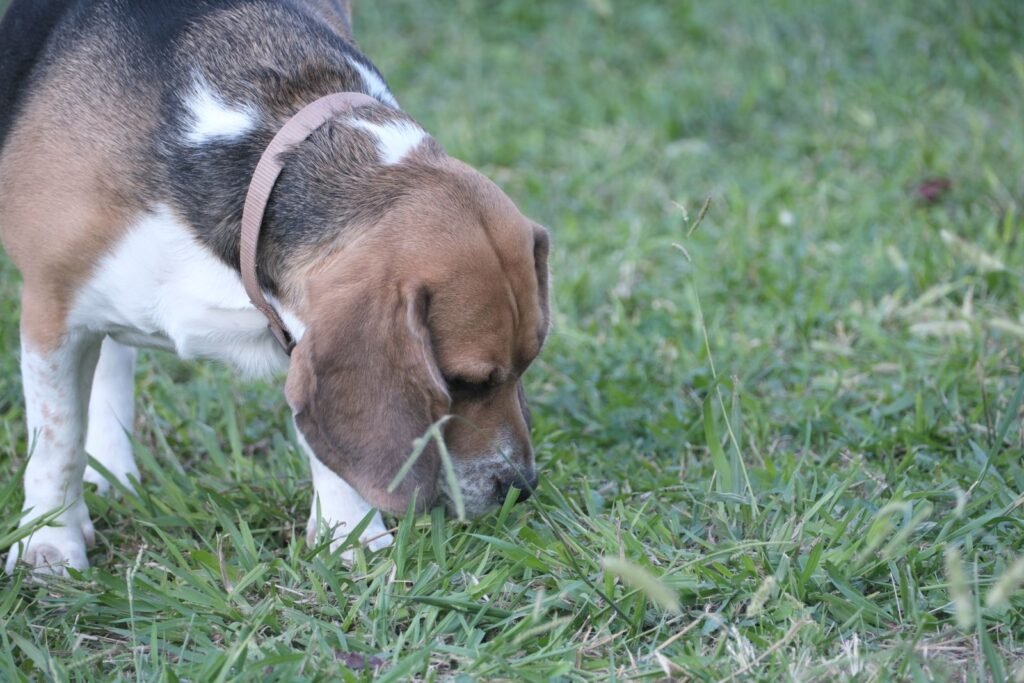
Scent training for dogs is the simplest way to tire out a busy brain without a single long walk. You teach your dog to find one smell, reward the find, then slowly make the hiding spots harder. Most dogs get the idea in their very first 10-minute session.
Picture a rainy Tuesday. Your young Lab has chewed a sock, barked at the mail carrier twice and is now staring at you like you owe him something. Ten minutes of hunting for a hidden treat later, he’s flat out on the rug, snoring. That’s the magic of nose work. Sniffing is hard mental work for a dog, and it uses the one sense they’re truly brilliant at.
This guide walks you through everything: what you need, how to start with games at home, how to move to real odors like birch, a 4-week plan, fixes for common problems and how to adapt it for puppies, seniors and nervous dogs.
This post contains affiliate links. We may earn a small commission at no extra cost to you. See our Disclosure.
🐾 Quick Answer: How Do You Start Scent Training a Dog?
- Start with food: play “Find It” and the cup game so your dog learns that sniffing pays.
- Add one odor: pair a birch-scented cotton swab in a tin with a treat every time your dog sniffs it.
- Hide it in boxes, then rooms, then new places. Make it harder only when your dog finds it fast.
- Keep it short: 5 to 10 minutes, 3 to 5 days a week, always ending on a win.
- Safety: your dog smells the odor but never touches or eats essential oils.
In this guide
What Is Scent Training for Dogs?
Scent training (also called nose work, scent work or smell training) teaches your dog to search for a specific smell and show you where it is. At home, that smell can be a treat or a toy. In the sport version, it’s a target odor such as birch oil on a cotton swab, hidden in a box, a room, a car bumper or a patch of grass.
Why does it work so well? Because your dog’s nose is in a different league from yours. VCA Animal Hospitals explains that dogs have far more scent receptors than people and a much bigger part of the brain devoted to smell. Estimates for dogs range from about 100 million to 300 million receptors, compared with roughly 6 million in humans. Where you smell “beef stew,” your dog smells the beef, the carrots, the onion and the spoon.
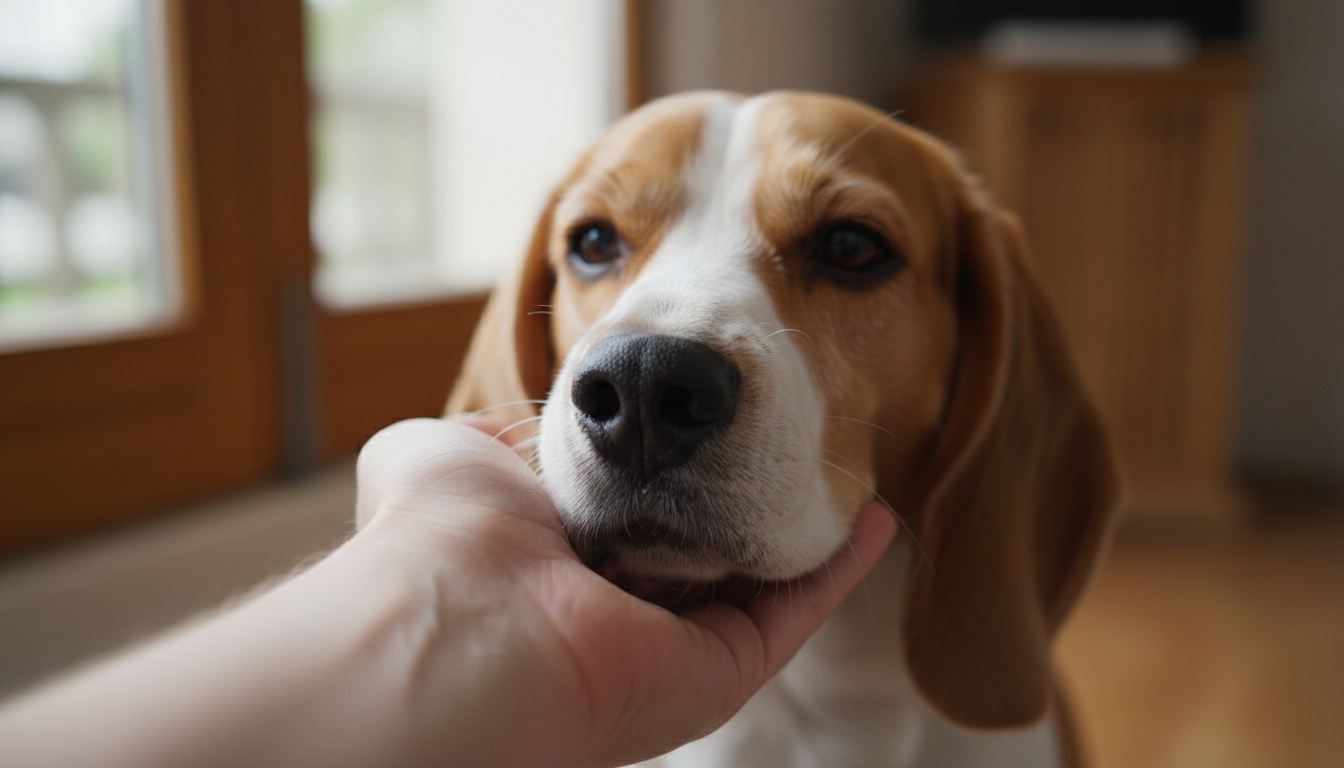
The best part is that you don’t need a hound. Any dog with a working nose can learn, from a Chihuahua to a Great Dane. A flat-faced breed like a Pug may tire sooner, so keep their rounds short and cool, but they still love the game.
So that’s what it is. Now let’s look at why it’s worth 10 minutes of your evening.
Benefits of Nose Work for Dogs
Nose work is more than a party trick. Here’s what owners and trainers notice most:
- A tired, calm dog. Ten minutes of focused sniffing can settle a dog as well as a much longer walk. It’s a lifesaver on icy or stormy days.
- More confidence. Shy dogs get to “win” over and over. Many start exploring new places with their nose instead of hiding behind your legs.
- A happier outlook. A 2019 study from Barnard College’s Dog Cognition Lab, “Let Me Sniff! Nosework Induces Positive Judgment Bias in Pet Dogs”, found that dogs who did nosework became more optimistic in a judgment test than dogs who practiced heelwork. It was a small study, but it fits what owners see.
- Less nuisance behavior. Many bored dogs bark, dig or chew because they need a job. Scent games give them one. If barking is your main struggle, pair this with our guide on how to stop dog barking.
- A stronger bond. You become a team. Your dog searches, you read their body language, and you both celebrate the find.
- Low impact. Searching at a walking pace is gentle on joints, which makes it ideal for older or recovering dogs (with your vet’s OK).
What You Need to Start Scent Training
You can start the food games tonight with things already in your kitchen. You only need the odor kit when you’re ready to move from treats to a real target scent.
| Item | Why you need it | Stage |
|---|---|---|
| 🍖 Small, smelly treats | Pea-size rewards your dog loves (cheese, chicken, soft treats) | Day 1 |
| 📦 6 to 10 cardboard boxes | Shoe boxes or delivery boxes for hiding spots | Day 1 |
| 🥤 3 identical cups or a muffin tin | For the cup game and muffin tin puzzle | Day 1 |
| 🌿 Birch essential oil | The first odor used in AKC Scent Work at Novice level | Week 1–2 |
| 🧴 Cotton swabs, cut in half | Carry 1 to 2 drops of odor | Week 1–2 |
| 🥫 Small metal tins with holes | Hold the swab so your dog smells it but can’t touch it | Week 1–2 |
| 🫙 Lidded glass jar | Stores scented swabs so the odor doesn’t spread | Week 1–2 |
| 🧤 Tweezers and disposable gloves | Keep odor off your hands, toys and furniture | Week 1–2 |
Odors used in the sport: birch first, then anise, clove and cypress at higher levels.
Don’t want to put together your own kit? A ready-made scent training game can be a handy shortcut, especially for the early food-based stage. These two are popular starter options:

- ✓ DOG SCENT TRAINING KIT FOR MENTAL STIMULATION: Turn daily play into a rewarding nosework routine. This scent training …
- ✓ INTERACTIVE ENRICHMENT GAME FOR ALL BREEDS & AGES: Designed for puppies, adults, and senior dogs, Find Fur Fun works a…
- ✓ HIDE-AND-SEEK NOSEWORK PLAY MADE SIMPLE: Set up fast and start in minutes. Hide the scented pouches, guide your dog to…
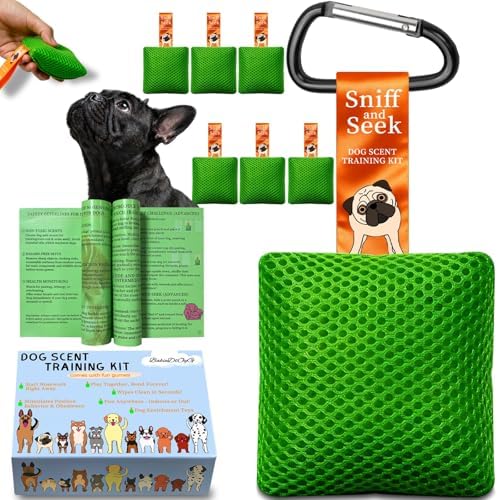
- 🦴BUILD BOND FOR PET OWNER & DOGS-Engage your dog’s brain with our interactive dog scent training kit. Perfect for mental…
- 🦴Indoor & Outdoor Dog Toys – Train your dog's nose to sniff out scents with dog nose work kit.Enhance your dog's indoor …
- 🦴PET SAFE FIRST& STIMULATE GOOD BEHAVIOR-Dog scent training kit made with all natural anise seed & corn cob, perfect Sce…
Honestly, though, a few cardboard boxes and good treats will take you a long way. Let’s put them to work.
7 Beginner Scent Games to Play at Home
These games teach the core skill, “use your nose to find the thing,” before any essential oil enters the picture. Start at the top and work down. Each one builds on the last.
- Find It. Say “Find it!” and toss a treat on the floor near you. Then toss it a little farther, then into the grass. Your dog learns the cue means “nose down, search.”
- The cup game. Put a treat under one of three identical cups while your dog watches. Let them sniff and nudge. When they pick the right one, lift it and let them eat. Later, hide it without them watching.
- Muffin tin puzzle. Drop treats in a few cups of a muffin tin and cover every cup with a tennis ball. Your dog has to sniff out which balls hide food.
- Box search. Line up 6 to 10 open boxes. Put a treat in one. Let your dog search. Move it to a different box each round.
- Room search. Hide a treat in one room at nose height: on a low shelf, under a chair leg, behind a door. Start easy, then add a second room.
- Hide and seek with a person. Have a family member hide behind a door with a treat. Say “Find Sam!” Kids love this one, and it builds recall too.
- Toy search. For toy-crazy dogs, hide their favorite toy instead of food and reward with a quick game of tug.
Here’s a real-life example. Maya, a 2-year-old shepherd mix, couldn’t settle after work. Her owner started with five rounds of the box game each evening. By day four, Maya was racing to the boxes when they came out, and she slept through the evening news. Small effort, big payoff.
Once your dog is searching happily for food, you can teach a target odor. That’s where the real scent training begins.
How to Teach Your Dog an Odor (Step by Step)
To teach a target odor, you pair the smell with food until your dog looks for the smell itself. This is the same method the American Kennel Club’s scent work guide uses, starting with birch.
Step 1: Prepare the odor
Put on gloves. Cut a few cotton swabs in half. Add about 2 drops of birch oil to each swab and store them in a small lidded glass jar for a few hours so the odor soaks in. When you train, use tweezers to place one swab inside a metal tin with holes in the lid.
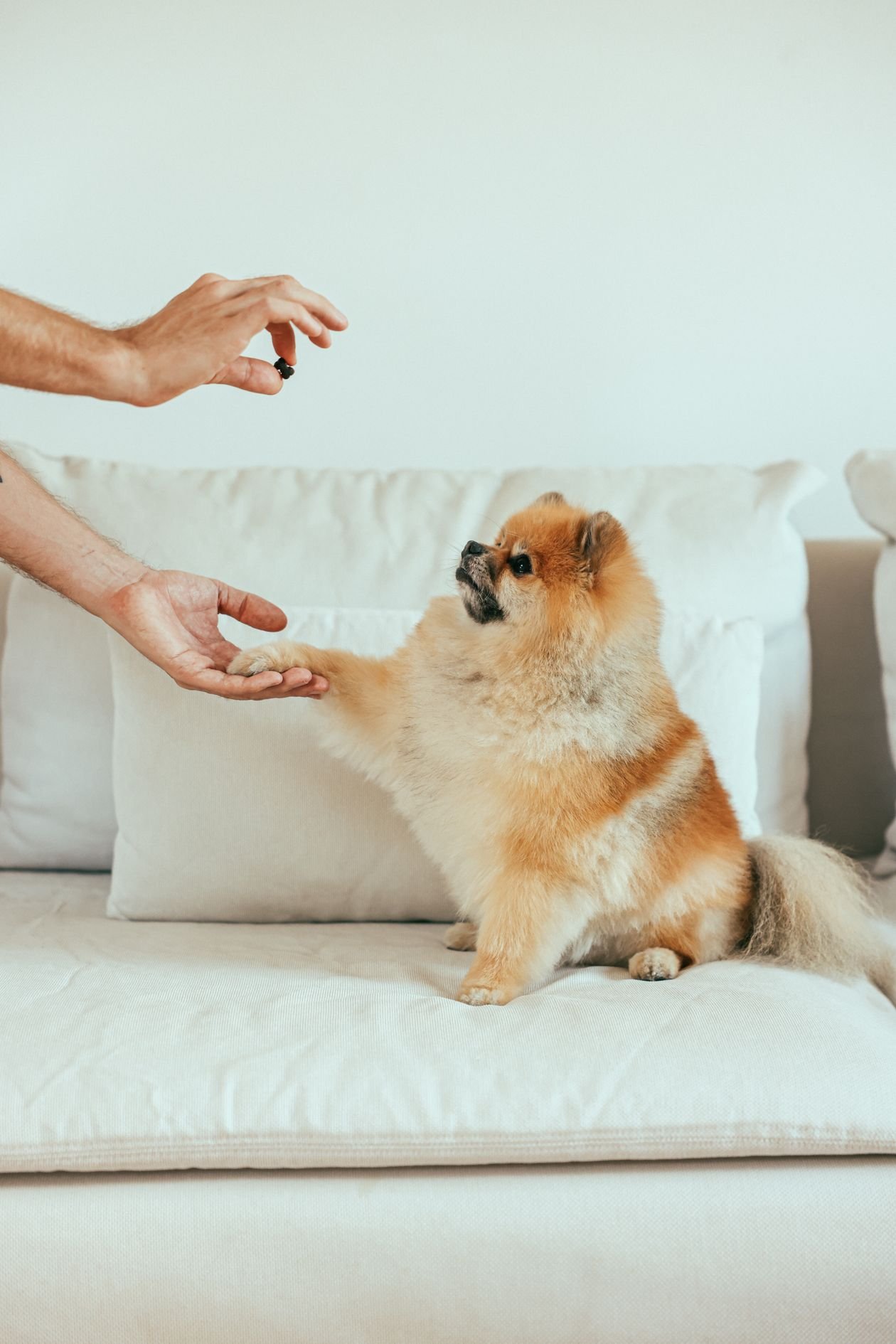
Step 2: Pair the odor with treats
Hold the tin in your open hand. The moment your dog sniffs it, say “Yes!” and give a treat right at the tin. Repeat 10 to 15 times. Your dog will start bumping the tin with their nose on purpose. That’s the lightbulb moment.
Step 3: Hide the odor in one of three boxes
Place the tin inside one of three boxes. Let your dog search. When their nose hits the right box, mark “Yes!” and drop a treat into that box, right next to the tin. Swap the box position every round.
Step 4: Add the cue and more boxes
Say your search cue (“Find it” or “Search”) just before you release your dog. Add more boxes, up to 10. Then try boxes stacked, turned on their side or scattered in a circle.
Step 5: Leave the boxes behind
Hide the tin in a room: under a couch leg, inside a boot, behind a trash can, low on a bookshelf. Then try the garage, the patio, the car tire (on a parked car only) and a quiet corner of the park.
Step 6: Teach an “alert” (optional)
For the sport, dogs show the find with a clear signal, such as freezing with their nose on the spot or sitting. Many dogs offer this naturally. Reward whatever steady behavior your dog gives at the hide, and it will grow stronger.
A 4-Week Scent Training Plan for Beginners
Want a schedule you can stick to? Here’s a simple plan. Keep sessions to 5 to 10 minutes. The Best Friends Animal Society suggests short searches of a minute or two each, with a whole session lasting no more than about 15 minutes.
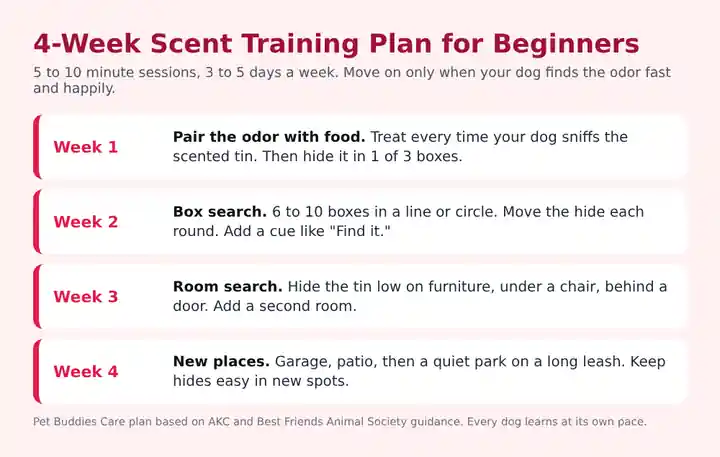
| Week | Goal | What a session looks like | Ready to move on when… |
|---|---|---|---|
| 1 | Love the odor | Odor-treat pairing, then 1 of 3 boxes | Your dog goes straight to the odor box |
| 2 | Search a line of boxes | 6 to 10 boxes, new spot each round | Finds it in under 30 seconds |
| 3 | Search a room | Hides low on furniture, behind doors | Searches the room on their own |
| 4 | New places | Garage, patio, then a quiet park on leash | Works through mild distractions |
Every dog learns at its own pace. Repeating a week is normal, not failure.
Moving outside is a big step. Wind carries the odor in odd directions, and squirrels exist. Use a long leash, pick a quiet spot, and make the first outdoor hides very easy. If you’d like to bring scent games on the trail, our guide to hiking with dogs covers safety and gear.
Essential Oil Safety in Scent Work
Concentrated essential oils can be harmful to pets if they’re swallowed or soaked into the skin. That’s why the sport uses tiny amounts on a swab, sealed in a tin. Your dog smells the odor. They never lick, chew or eat it.
✅ Odor Safety Checklist
- ☐ Gloves and tweezers every time you handle oil or swabs
- ☐ About 2 drops per swab half, no more
- ☐ Swabs always inside a tin, never loose on the floor
- ☐ No oil on your dog, their bed, collar or toys
- ☐ Oils and swabs stored in a sealed jar, out of reach
- ☐ Swallowed a swab or licked oil? Call your vet or the ASPCA Animal Poison Control Center at (888) 426-4435 (a fee may apply)
Prefer to skip oils entirely? That’s fine. Plenty of families keep scent training as a food and toy game forever, and their dogs are just as happy. If you have cats or birds at home, ask your vet before using any essential oils in the house.
Scent Training for Puppies, Seniors and Reactive Dogs
Puppies
Puppies can play food-based “Find It” and cup games as soon as they come home. Keep it to a few minutes, because little brains tire fast. Hold off on essential oils until your puppy is older and has good impulse control. Our puppy growth chart and stages guide shows what’s normal at each age.
Senior dogs
Older dogs often shine at nose work. It’s slow, thoughtful and kind to stiff joints. Place hides at nose height so they don’t have to jump or crouch, use non-slip flooring, and keep sessions short. A dog whose eyesight or hearing is fading can still search well by smell, which makes this a wonderful way to keep their mind sharp. If you’re noticing age changes, see how long dogs live and the signs of aging.
Reactive or anxious dogs
Nose work is a favorite with trainers for dogs who struggle around other dogs. In classes, dogs usually search one at a time while the others wait out of sight, and Best Friends notes that one-on-one sessions work well even for dogs who are reactive. At home, sniffing can help an anxious dog wind down. For a fuller plan, read our guide on how to reduce anxiety in dogs, and talk to your vet if anxiety is severe or new.
Common Scent Training Problems and How to Fix Them
| Problem | Likely cause | Try this |
|---|---|---|
| Dog wanders off | Too hard, too long or too distracting | Go back a step, use better treats, train in a quieter room |
| Dog stares at you instead of searching | Waiting for a hint | Stand still and quiet; let them figure it out |
| Dog paws or bites the tin | Rewarded too late | Mark “Yes!” the second the nose hits; use heavier tins |
| Dog finds the box you touched, not the odor | Following your scent | Handle every box, even empty ones |
| Dog loses interest outside | Too many new smells | Make outdoor hides very easy at first, short rounds |
| Dog gets frantic | Over-excited | Fewer reps, calmer voice, end with an easy find |
Distractions deserve a special note. Start in a quiet room. Add one distraction at a time: a TV on, then a family member walking past, then a toy on the floor. If your dog loses focus, calmly guide them back to the search area and make the next hide easier. Patience here pays off big later.
Mistakes to Avoid
- Making it harder too fast. The number one mistake. If your dog misses twice, make the next hide easier.
- Helping with your hands or eyes. Pointing or staring at the hide teaches your dog to watch you, not to sniff.
- Sessions that drag on. Stop while your dog still wants more. Ten great minutes beat 30 tired ones.
- Boring rewards. Use the best treats you have. Search work is hard, so pay well. Our easy homemade dog treat recipes make great training rewards, and they count toward your dog’s daily calories.
- Contaminating your gear. Odor on your fingers ends up on every box. Gloves and tweezers solve it.
- Training a sick, sore or overheated dog. Heavy panting dulls the nose. Train in cool conditions and skip days when your dog isn’t well.
Scent Work Classes and the Sport
When your dog is finding odor all over the house, you might wonder what’s next. A class is a great step. A good instructor helps you read your dog, sets up searches you can’t easily build at home and introduces new places and distractions in a controlled way.
If you enjoy a goal, try the sport. AKC Scent Work has searches in containers, interiors, exteriors and buried items, plus a “handler discrimination” search where your dog finds your own scent. Novice dogs search for birch; higher levels add anise, clove and cypress. The National Association of Canine Scent Work (NACSW) runs its own trials too, and Best Friends notes you need to pass an odor recognition test before competing there.
Some teams go even further and volunteer for search and rescue or detection roles. That takes specialist training and a big time commitment, but it all starts with the same simple box game you play in your living room.
Frequently Asked Questions
How often should I practice scent training?
Short sessions 3 to 5 days a week work well for most dogs. Aim for 5 to 10 minutes and stop while your dog is still keen. Regular short practice beats one long weekend session.
Can any dog breed do scent training?
Yes. Hounds and working breeds may take to it quickly, but every dog has a powerful nose. Mixed breeds, toy breeds and seniors all enjoy it. Flat-faced breeds should work in short, cool sessions.
What scent is best for beginner dog scent training?
Start with food, then birch. Birch is the first odor in AKC Scent Work, and a cotton swab with about 2 drops in a closed tin is plenty. Anise and clove come later.
Is scent work safe for dogs with essential oils?
It’s considered safe when your dog only smells the odor. Use tiny amounts, keep swabs in closed tins, never put oil on your dog and store oils out of reach. Call your vet if your dog swallows a swab or licks oil.
How long does it take to train a dog in nose work?
Most dogs learn the food games in a session or two. Learning a target odor and searching rooms usually takes a few weeks of short practice. Competition-level skills take months.
What are the signs of progress in scent training?
Your dog gets excited when the boxes come out, searches more methodically, finds the hide faster and shows you a clear signal at the source. Celebrate every one of those wins.
The Bottom Line
Scent training for dogs doesn’t need fancy gear or hours of free time. Start with treats and a few boxes, add birch odor once your dog loves the game, and build up one small step at a time. Keep sessions short, stay quiet while your dog works, and pay well for every find.
Give it four weeks. You’ll likely end up with a calmer, more confident dog and a game you can play on any rainy day for the rest of their life. And if your dog has a health condition, check with your vet before starting a new activity.
Keep learning: more guides from Pet Buddies Care
- How to reduce anxiety in dogs
- How to stop dog barking: 7 training methods that work
- Hiking with dogs: safety tips and gear checklist
Sources: American Kennel Club (scent work training guide and AKC Scent Work); VCA Animal Hospitals; Best Friends Animal Society; Duranton & Horowitz, “Let Me Sniff! Nosework Induces Positive Judgment Bias in Pet Dogs,” Applied Animal Behaviour Science (2019); ASPCA Animal Poison Control Center. Updated November 2026. This guide is general information, not veterinary advice. Check with your vet about your own dog.
What’s your dog’s favorite scent game so far? Tell us in the comments.