This post contains affiliate links. We may earn a small commission at no extra cost to you. See our disclosure.
To start a dog grooming business, get trained, choose a model (home, mobile van or storefront salon), check your local licensing and zoning rules, buy insurance and core equipment, then price by the hour and market to local pet owners. A home-based setup can start for a few thousand dollars. A van or salon usually takes tens of thousands.
Maybe you’re the friend everyone calls when their doodle is matted. Or you’ve worked in a salon for three years and you’re tired of earning a commission on someone else’s business. Either way, the demand is real. The question is how to open a pet grooming business without burning through your savings in the first six months.
This guide walks you through it with real numbers: startup costs by model, what licenses actually look like, a pricing formula you can use tomorrow, and the mistakes that sink new groomers.
✂️ Quick Answer: How to Start a Dog Grooming Business
- Skills first: train at a grooming school or apprentice under a working groomer.
- Pick a model: home-based (about $2,000 to $10,000), mobile van (about $20,000 to $100,000) or storefront salon ($10,000 to $100,000+).
- Make it legal: register the business, get local licenses, and check state rules. Connecticut and Colorado, for example, license grooming facilities.
- Protect it: general liability plus bailee coverage for pets in your care.
- Price by time: hours on the table × your hourly rate + supplies + coat surcharges.
In this guide
- Is a dog grooming business worth it in 2026?
- Home, mobile or salon: choose your model
- How much it costs to start
- How to start a dog grooming business in 10 steps
- Equipment and supplies checklist
- How to price grooming services
- How to get your first clients
- Safety and customer experience
- Growing your business
- Mistakes to avoid
- FAQ
Is a Dog Grooming Business Worth It in 2026?
Yes, for the right person. The market is big and steady. According to the American Pet Products Association’s latest State of the Industry report, U.S. pet spending reached $158 billion in 2025 and is projected to hit $165 billion in 2026. About 95 million households own a pet, and 71 million of them have a dog.
Here’s why grooming in particular holds up. You can’t order a haircut online. Doodles, poodles, shih tzus and other high-maintenance coats need professional care every 4 to 8 weeks, which turns one happy client into 6 to 12 visits a year. The U.S. Bureau of Labor Statistics projects 11% job growth for animal care and service workers from 2025 to 2035, much faster than average.
Now the honest part. Grooming is physical work. You’ll lift 70-pound dogs, stand all day, and handle the occasional biter. The BLS lists the 2025 median pay for animal care and service workers at $35,530, so the real upside comes from owning the business and setting your own prices, not from the job title alone.
✅ Quick self-check before you invest
- ☐ Can you stay calm with a scared, wiggly or snappy dog?
- ☐ Can you be on your feet 6 to 8 hours and lift heavy dogs safely?
- ☐ Are you comfortable with bookkeeping, scheduling and difficult customers?
- ☐ Do you have savings for 3 to 6 months of slow start-up?
If you checked most of those boxes, the next decision shapes everything else: where you’ll actually groom.
Home, Mobile or Salon: Choose Your Model
Your model decides your costs, your licenses and how many dogs you can see in a day. Picture three groomers in the same town. Maria converts her garage and grooms 4 dogs a day with almost no rent. Devon buys a used van and charges more for the convenience, but drive time caps him at 4 to 6 dogs a day, a range Gingr’s guide also cites. Priya leases a small storefront, hires a bather, and handles 10 or more dogs a day, but she has rent due on the first of every month.
| Model | Typical startup cost | Dogs per day (solo) | Pros | Watch out for |
|---|---|---|---|---|
| 🏠 Home-based | $2,000–$10,000 | 3–5 | Lowest cost, no commute | Zoning, HOA rules, drainage, insurance exclusions |
| 🚐 Mobile van | $20,000–$100,000 | 4–6 | Premium prices, loyal clients, less stress for anxious dogs | Van loan, fuel, water and generator upkeep, parking rules |
| 🏪 Storefront salon | $10,000–$100,000+ | 8+ with staff | Room to grow, walk-in visibility, add-on retail | Lease, plumbing, build-out, payroll |
Cost ranges from The Academy of Pet Careers (2025) and ZenBusiness (updated August 2026). Dogs per day are typical for a solo groomer and vary by breed mix.
Many successful groomers start at home or rent a chair in an existing salon, build a client list, then move to a van or storefront once they’re booked solid. That path keeps your risk low while you learn what your local customers will pay.
How Much Does It Cost to Start a Dog Grooming Business?
Most new groomers spend somewhere between $2,000 and $100,000, and the model you choose explains almost all of that gap. Here’s how the ranges compare.
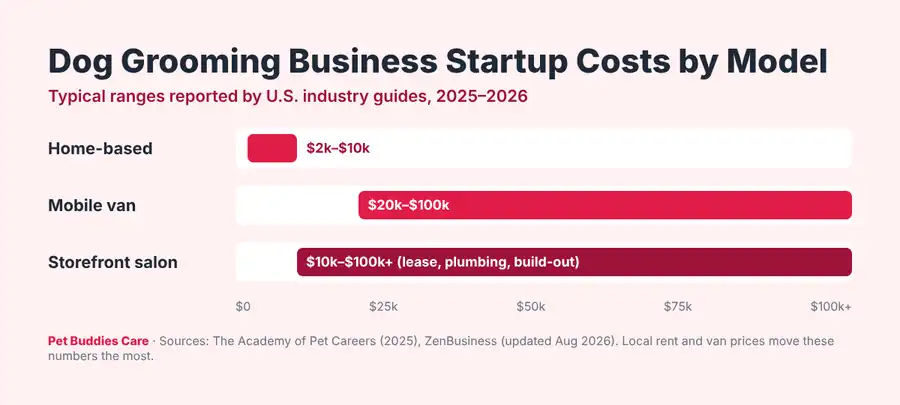
And here’s where that money typically goes:
| Cost item | What it covers | Notes |
|---|---|---|
| Training | Grooming school or apprenticeship | Ranges widely by program length |
| Business setup | LLC or sole proprietor filing, local business license | State filing fees vary; Connecticut’s grooming facility license is $200 |
| Insurance | General liability, bailee (animals in your care), commercial auto for vans | Get quotes from pet-business insurers |
| Grooming equipment | Table, tub, high-velocity dryer, clippers, blades, shears, brushes | Buy pro-grade clippers and dryer; save elsewhere |
| Space or vehicle | Garage conversion, van build-out, or salon lease and plumbing | The biggest variable by far |
| Supplies | Shampoo, conditioner, ear cleaner, towels, sanitizer | Buy in bulk once you know your volume |
| Software and marketing | Booking app, website, signage, cards | Many booking tools charge monthly |
| Cash cushion | 3 to 6 months of fixed costs | The line most new owners skip |
How to Start a Dog Grooming Business in 10 Steps
Here’s the full roadmap. Steps 5 and 6 are the ones people rush, and they’re the ones that can shut you down, so give them real attention.
Step 1: Get trained (even though most states don’t require it)
Most states don’t license individual groomers, but clients and insurers care about skill. Your options are a grooming school, an online course with hands-on practice, or an apprenticeship under an experienced groomer. Voluntary certification, such as through the National Dog Groomers Association of America, can help you stand out. Learn breed cuts, handling, skin and coat problems, and basic pet first aid.
Step 2: Pick your model and study your local market
Use the comparison table above, then do some homework. Search Google Maps for “dog groomer near me” in your area. How many are there? What do they charge? Are they booked out three weeks? Read their reviews: complaints about long waits or rough handling point to gaps you can fill. Decide who you’re for, whether that’s busy families, doodle owners, senior dogs or anxious dogs.
Step 3: Write a simple business plan and run the numbers
Your plan doesn’t need to be 40 pages. It needs to answer: what services, at what prices, for how many dogs a week, against what costs? Here’s a quick sanity check. A solo groomer seeing 5 dogs a day at an average of $70, 5 days a week for 48 weeks, brings in about $84,000 before expenses. Then subtract rent or van payments, supplies, insurance, software, and taxes. Many advisers suggest setting aside 25% to 35% of revenue for taxes.
Need money to start? Options include personal savings, a small business loan, an equipment loan, or financing from a van builder. Keep your plan updated as real numbers come in.
Step 4: Choose a business structure and register it
Your structure affects taxes and how much personal risk you carry. Many solo groomers form an LLC so a lawsuit against the business doesn’t reach their personal savings as easily. Get a free Employer Identification Number (EIN) from the IRS, and open a separate business bank account.
| Structure | Advantages | Disadvantages | Best for |
|---|---|---|---|
| Sole proprietorship | Easy to form, simple taxes | Unlimited personal liability | Testing the idea part-time |
| Partnership | Shared money and skills | Partners share liability | Two groomers going in together |
| LLC | Limited liability, flexible taxes | More paperwork and state fees | Most full-time groomers |
| Corporation | Limited liability, easier to raise money | More formalities, possible double taxation | Multi-location businesses |
This is general information, not legal or tax advice. Talk to an accountant or attorney about your situation.
Step 5: Get licenses, permits and zoning approval
Rules depend on your state, county and city, so start this step early. Most groomers need a general business license and, in many places, a sales tax permit if they sell shampoo or accessories. Some states go further. Connecticut law requires anyone in the business of grooming to hold a grooming facility license from the state Department of Agriculture, currently a $200 fee for a two-year license, and the department’s renewal notice lists grooming facilities among its licenses. Colorado licenses grooming facilities, including mobile groomers, under its Pet Animal Care and Facilities Act, which lawmakers took up for renewal in HB26-1183.
Working from home? Call your city’s zoning office before you buy anything. Home businesses with customer visits, signs or extra wastewater sometimes need a permit, and HOAs can have their own rules. Boarding dogs overnight usually triggers a separate kennel license.
Step 6: Buy the right insurance
Accidents happen, even to careful groomers: a nicked ear, a dog that jumps off the table, a client who slips on a wet floor. At minimum, look at general liability and bailee coverage (which covers animals in your care, custody and control). Add commercial auto insurance for a van, property coverage for your equipment, and workers’ compensation once you hire, as your state requires. Ask any home-based policy whether it excludes business use.
Step 7: Set up and equip your grooming space
Plan your space around the dog’s path: check-in, bath, dry, table, pickup. Use non-slip floors and mats, good lighting, ventilation, secure crates or holding areas, and outlets placed where cords won’t trip you. Make sure drains have hair traps. The full equipment list is in the next section.

Step 8: Set your prices
Price by time, not by guesswork. We’ll walk through the formula with real examples in the pricing section below.
Step 9: Set up booking, forms and policies
Online booking with automatic reminders cuts no-shows. Create an intake form that covers vaccines, health issues, behavior and emergency contacts, plus a release that explains how you handle matted coats and aggressive dogs. Write clear policies for late arrivals, no-shows, late pickups and matting fees, and share them before the first appointment.
Step 10: Get your first clients
Your first 30 clients usually come from people who already know you, local search and referrals. We cover the exact tactics in the marketing section below.
Dog Grooming Equipment and Supplies Checklist
Good tools make your work faster and keep pets safe and comfortable. Here’s what a new groomer needs on day one:
- Grooming table with an adjustable height and a grooming arm and loop. An electric lift table saves your back with big dogs.
- Bathing tub with a ramp or steps, a sprayer and a hair trap on the drain.
- High-velocity dryer plus a stand dryer if you can. Never leave a dog alone under a heated cage dryer.
- Clippers and blades in several lengths, plus guard combs, coolant and spare blades.
- Shears: straight, curved, thinning and safety-tip scissors for faces and paws.
- Brushes and combs: slicker brush, metal comb, undercoat rake and dematting comb.
- Nail tools: clippers, a grinder and styptic powder. Our guide on using dog nail clippers on cats explains why cats need their own tools.
- Products: shampoos for different coats and sensitive skin, conditioner, ear cleaner, and a pet-safe disinfectant.
- Safety gear: muzzles in several sizes, a pet first-aid kit, a fire extinguisher, and towels by the dozen.
Here are a few tools new groomers often start with. Check current prices, ratings and specs on Amazon before you buy, and choose a table rated for the largest dogs you plan to groom.
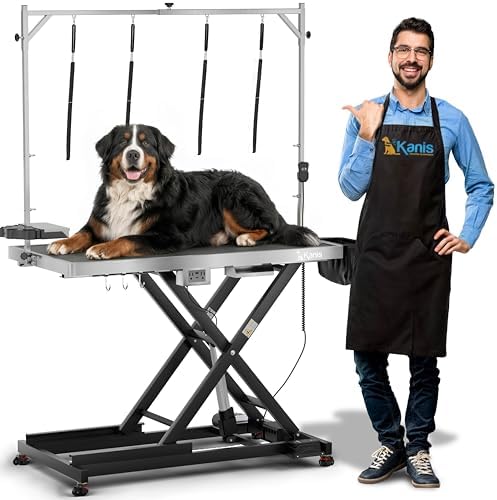
- ALL-IN-ONE WORKSPACE! KANIS is introducing the industry's most innovative Stainless Steel Grooming table for Dogs! Mobil…
- FUNCTIONAL & CONVENIENT FEATURES like Hand & Foot Control, Circuit Breaker, Retractable Caster Wheels, Tool Storage Orga…
- DESIGNED FOR STRENGTH AND DURABILITY – The professional electric grooming table features a powerful top-class linear act…

- ★Professional Pet Grooming Scissors Kit★-The kit includes 1 × 6.5-inch thinning shear, 1 × 6.5-inch curved scissor, 1 × …
- ★Round-end Tips for Maximum Safety★-Never need to worry about poking your pet's skin, because all dog scissors for groom…
- ★Extremely High Quality Stainless Steel★-The round tips of pet scissors are made of 4CR Titanium Coated Stainless Steel,…

- What Your Pet Needs: Tired of Uncomfortable Pet Grooming Sessions? Try Our Adjustable Screw Scissors. Part of Pawtrim's …
- Superior 4CR Stainless Steel Build: Our sturdy and enduring Dog clippers for grooming, meticulously built from this top-…
- Thoughtfully Designed for Comfort and Precision: From strong rubber grips and safety round tips to sharp blades and adju…
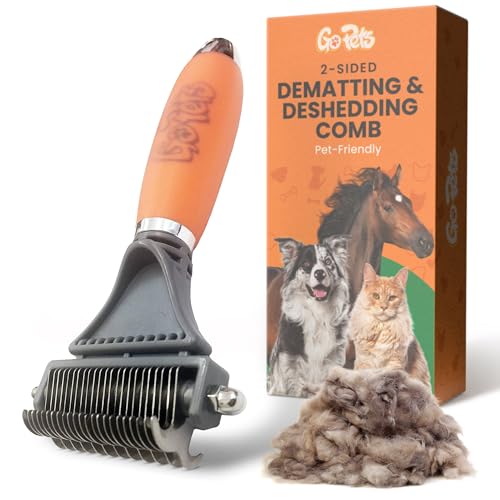
- VERSATILE SHEDDING & DEMATTING COMB – Our dual-sided grooming brush combines a 12-blade dematting comb for dogs and cats…
- KEEPS HOME CLEAN & PETS WELL-GROOMED – Our dual-purpose dog brush for shedding and dematting tool for cats captures loos…
- COMFORTABLE & PAIN-FREE GROOMING – Designed with gentle yet efficient blades, this dog detangler comb and cat dematting …

- DUAL-SIDED DESIGN: Our Undercoat Rake Dog brush is perfect for deshedding your pet's coat. Designed with a dual-sided de…
- HEALTHY COAT AND REDUCED SHEDDING: Our deshedding brush for dogs is designed with sharpened but finely rounded teeth tha…
- EFFECTIVE DESHEDDING TOOL: This dematting and deshedding brush gently removes loose hair and eliminates tangles, knots, …
For shampoos and conditioners, choose gentle formulas from established brands and keep a hypoallergenic option for sensitive skin. Once you know your weekly volume, a pet supply wholesaler usually beats retail prices.
How to Price Dog Grooming Services
The simplest fair method is to charge for your time. Decide what an hour on the table needs to earn to cover your costs and pay you, then multiply by how long each dog takes. Add the cost of supplies, plus a surcharge for extra work like matting or difficult handling. Gingr’s guide uses a similar time-based formula.
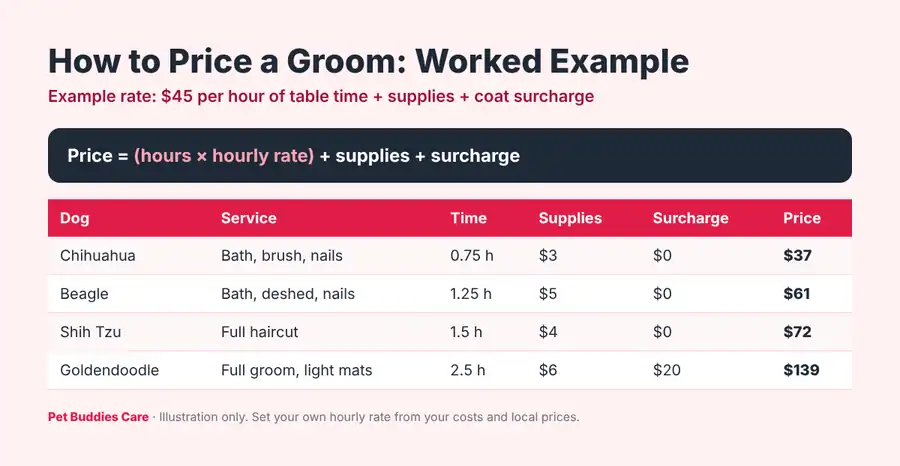
Look at the goldendoodle row. A full groom with light mats takes about 2.5 hours, so at $45 an hour plus $6 in supplies and a $20 matting fee, the price lands near $139. If you charged that dog the same as a beagle, you’d lose money every visit. That’s why size, coat type and condition all belong in your price list.
- Check local prices, then position yourself. Don’t start as the cheapest in town; it’s hard to raise prices later.
- Offer add-ons: teeth brushing, nail grinding, deshedding treatments, paw balm.
- Reward rebooking: a small discount for clients who book every 4 to 6 weeks keeps coats easier and your calendar full.
- Review prices once a year as your skills, demand and costs change.
Clients often weigh grooming as one line in their yearly pet budget. Our guide to how much a dog costs per year shows how grooming fits next to food, vet care and insurance.
How to Get Your First Grooming Clients
Most pet owners find a groomer by searching on their phone or asking a friend. So focus on being easy to find and easy to recommend.
- Set up a Google Business Profile with your service area, hours, prices and photos. Ask every happy client for a review.
- Post before-and-after photos on Instagram, Facebook and TikTok. Always ask the owner’s permission first.
- Partner locally. Leave cards with vets, dog walkers, trainers, doggy daycares and pet stores, and offer them a referral thank-you.
- Run a launch offer, like a discounted first nail trim or a free add-on with a first full groom.
- Share helpful content: short videos on brushing between visits, or the best haircut length for summer. It builds trust before anyone books.
- Rebook at checkout. The easiest client to keep is the one standing in front of you.
Your brand matters too, but keep it simple: a clear name, a clean logo, and colors that say “calm and clean.” Want to see how established groomers present themselves? Our roundup of pet groomers in Myrtle Beach, SC shows what local salons highlight.
Safety and Customer Experience
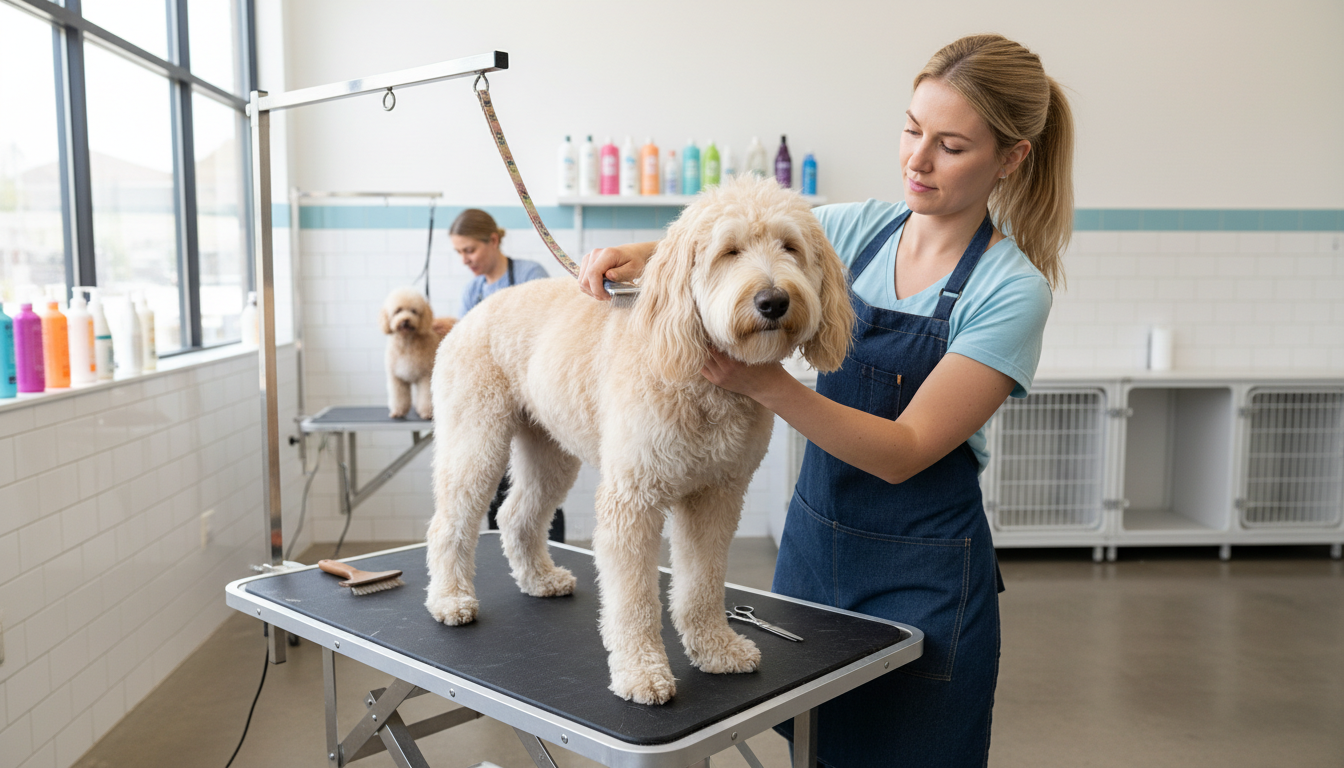
Your reputation rests on one promise: the dog comes home safe and happy. Never leave a dog unattended on the table or in a dryer. Use the right restraint for each dog, keep floors dry, and sanitize tools between every pet. If a dog is too stressed, stop and talk to the owner. A partial groom is better than an injury. Our guide on how to reduce anxiety in dogs has calming ideas you can share with nervous owners.
Great service is often small things: texting a photo when the dog is ready, noting a lump or ear infection for the owner to check with their vet, and remembering that Bella hates the dryer on her face. That’s what turns a one-time client into a ten-year one.
Growing Your Grooming Business
Once your calendar stays full several weeks out, it’s time to grow. Common next steps include raising prices, hiring a bather so you can focus on cuts, adding a second table or van, offering cat grooming, or adding services like teeth brushing and deshedding packages. Keep investing in training on breed cuts, handling difficult pets and spotting skin problems. Before each big move, check your numbers and make sure demand is really there.
Mistakes to Avoid When Opening a Pet Grooming Business
- Underpricing. Being the cheapest groomer fills your day but empties your bank account.
- Skipping zoning and licensing checks. Finding out after you’ve built a garage salon is expensive.
- Buying the van or lease before the clients. Build a list first if you can.
- No written policies. Matting, no-shows and aggressive dogs cause the most disputes.
- Overbooking your body. Burnout and back injuries end grooming careers. Schedule breaks and use lift tables.
- Mixing personal and business money. It makes taxes painful and weakens LLC protection.
Frequently Asked Questions
How much does it cost to start a dog grooming business?
Industry guides put a home-based start at about $2,000 to $10,000, a mobile van at about $20,000 to $100,000, and a storefront salon at $10,000 to more than $100,000. Rent, van prices and build-out costs cause most of the difference.
Do you need a license to start a dog grooming business?
Usually you need at least a local business license. Most states don’t license individual groomers, but some license grooming facilities. Connecticut and Colorado are examples. Check with your city, county and state agriculture department before you open.
Can I run a dog grooming business from home?
Yes, many groomers start at home. Check local zoning and any HOA rules first, make sure your drain can handle hair, and confirm your insurance covers business use.
Is a dog grooming business profitable?
It can be. A solo groomer seeing 5 dogs a day at an average of $70, five days a week for 48 weeks, would gross about $84,000 before expenses. Profit depends on your prices, rent or van costs and how full your calendar stays.
How do I price my grooming services?
Multiply the hours a groom takes by your hourly rate, then add supplies and any surcharge for matting or difficult handling. Compare the result with local prices and adjust for size, coat type and condition.
Do I need certification to be a dog groomer?
Most states don’t require it, but training and voluntary certification build skills and client trust. Many groomers attend a grooming school, apprentice with an experienced groomer, or both.
The Bottom Line
Starting a dog grooming business comes down to a few smart choices made in the right order. Get trained, pick the model that fits your budget, handle licensing and insurance before you open, and price by your time so every dog pays its way.
Start small if you need to. A home setup or a rented chair is a great way to prove your prices and build a loyal client list. Then grow into the van or salon when your calendar tells you it’s time. Ready to begin? Make your local licensing call this week. It’s the step that shapes everything else.
Keep learning: more guides from Pet Buddies Care
- What you need to know about pet first aid
- How much does a dog cost per year? 2026 budget guide
- Pet groomers in Myrtle Beach, SC
Sources: American Pet Products Association (2026 State of the Industry release); U.S. Bureau of Labor Statistics, Occupational Outlook Handbook; Connecticut Department of Agriculture and Conn. Gen. Stat. § 22-344; Colorado General Assembly (HB26-1183); The Academy of Pet Careers; ZenBusiness; Gingr. Updated November 2026. This is general information, not legal, tax or financial advice.
Thinking about starting your own grooming business? Tell us which model you’re leaning toward in the comments.